
Global Data Storage Tape Market - Global Outlook 2021-2033
Global Data Storage Tape Market is segmented by Application (Data Centers, Cloud Backup, Archival Storage, Banking Systems, Government Records), Type (LTO Tapes, Magnetic Tape Libraries, Archival Tapes, Digital Storage Tapes, Enterprise Backup Tapes), and Geography (North America, LATAM, West Europe, Central & Eastern Europe, Northern Europe, Southern Europe, East Asia, Southeast Asia, South Asia, Central Asia, Oceania, MEA)
Pricing
Report Overview
Key Aspects of the Market Report
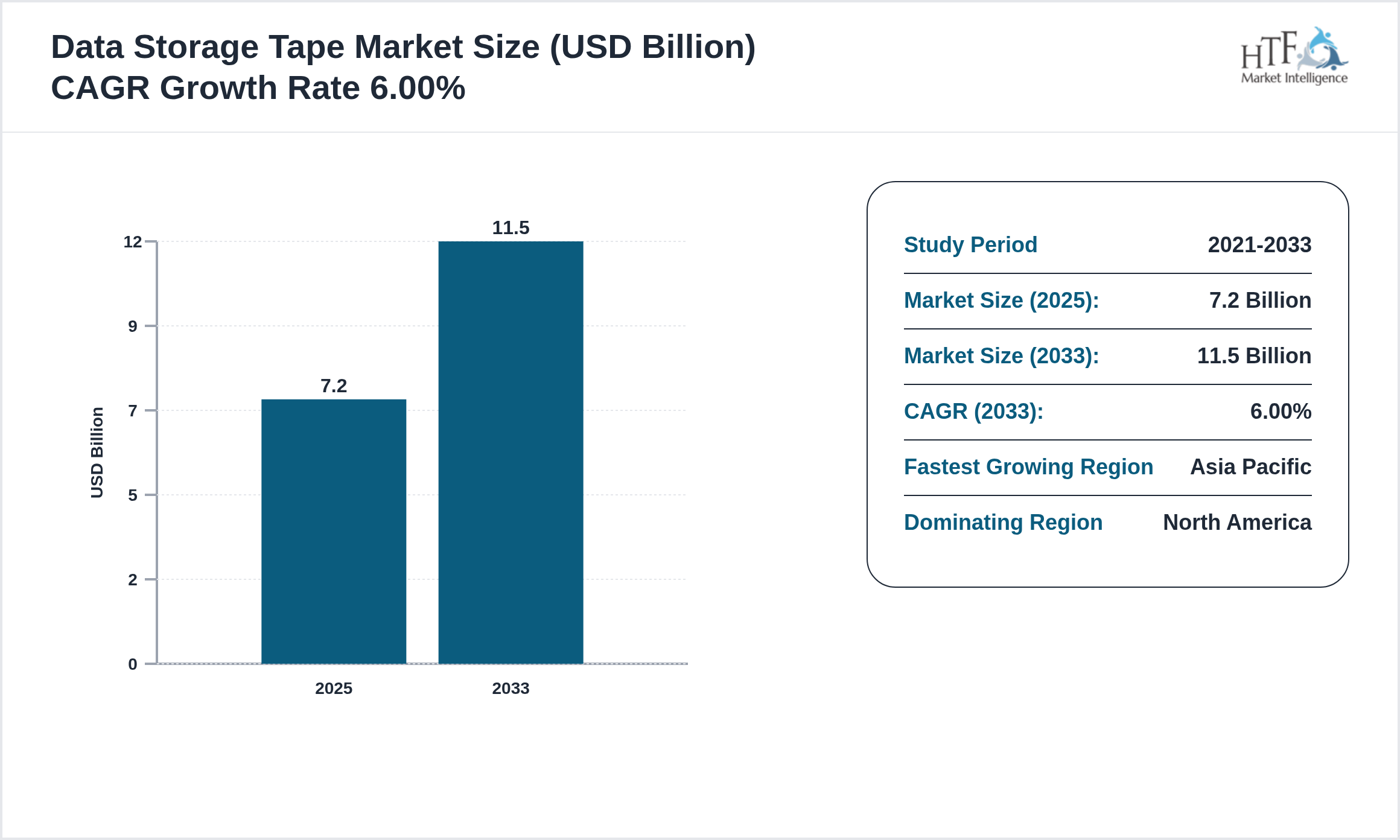
The Data Storage Tape is growing at 6.00% and is expected to reach 11.50 billion by 2033. Below are some of the dynamics shaping the Data Storage Tape.
The Global Data Storage Tape Market encompasses the international data management and archival storage industry focused on magnetic tape technologies used for long-term data backup, disaster recovery, cloud storage support, and enterprise-level information archiving. Data storage tapes provide high-capacity, energy-efficient, and cost-effective storage solutions for government organizations, financial institutions, healthcare systems, research centers, and hyperscale data centers. North America leads technological development and adoption due to large enterprise IT infrastructure and cloud computing expansion, while Europe and Asia-Pacific demonstrate growing demand from digital transformation initiatives and regulatory data retention requirements. Technological advancements in Linear Tape-Open (LTO) systems, storage density enhancement, and cybersecurity-integrated tape solutions continue improving reliability and scalability. Rising global data generation, increasing cybersecurity concerns, and long-term archival requirements are accelerating market demand. The market remains strategically important for cold storage infrastructure, enterprise backup systems, and sustainable large-scale data preservation operations worldwide.
Source: HTF Market Intelligence (HTF MI)
A Data Storage Tape market research report effectively communicates vital insights through several key aspects. It begins with an executive summary that concisely outlines the findings, conclusions, and actionable recommendations, allowing stakeholders to quickly grasp essential information. Clearly stating the research objectives ensures the purpose and specific questions being addressed are understood. The methodology section describes the research methods employed, such as surveys or focus groups, and provides a rationale for their selection to establish credibility. A market overview presents the industry landscape, including market size, growth trends, and key drivers.
Additionally, the segmentation analysis examines distinct market segments to identify varied customer needs. The competitive analysis offers insights into major competitors, highlighting their strengths and weaknesses. Finally, the report concludes with key findings and insights, followed by conclusions and recommendations that provide actionable strategies to guide future business decisions.
Geographic Analysis of Data Storage Tape
The Data Storage Tape market exhibits significant regional variation, shaped by different economic conditions and consumer behaviors.
Currently, North America dominates the market due to high consumption, population growth, and sustained economic progress. Meanwhile, Asia Pacific is experiencing the fastest growth, driven by large-scale infrastructure investments, industrial development, and rising consumer demand.
- North America
- LATAM
- West Europe
- Central & Eastern Europe
- Northern Europe
- Southern Europe
- East Asia
- Southeast Asia
- South Asia
- Central Asia
- Oceania
- MEA
Data Storage Tape Market Dynamics
Influencing Trend:
- • High-density magnetic tape technologies improving long-term storage efficiency globally significantly rapidly
- • Energy-efficient archival storage solutions gaining traction across enterprise data centers worldwide
- • Hybrid cloud and tape storage systems expanding within enterprise infrastructure globally significantly
- • AI-driven data management improving tape storage retrieval and operational optimization worldwide rapidly
- • Advanced encryption technologies enhancing tape storage cybersecurity capabilities globally significantly
Market Growth Drivers:
- • Rising enterprise data generation increasing demand for high-capacity storage tape solutions globally
- • Expanding cloud infrastructure supporting long-term archival data storage investments worldwide significantly
- • Cybersecurity concerns driving offline backup storage adoption across enterprises globally significantly
- • Financial institutions increasing utilization of secure tape-based archival systems worldwide rapidly
- • Growing media content storage requirements strengthening enterprise tape demand globally significantly
Challenges:
- • Competition from solid-state and cloud storage reducing tape storage adoption globally significantly
- • High maintenance requirements affecting operational efficiency of tape storage systems worldwide significantly
- • Skilled workforce shortages limiting enterprise tape infrastructure management globally rapidly significantly
- • Technological obsolescence concerns impacting long-term storage investment decisions worldwide significantly
- • Supply chain disruptions affecting magnetic tape material availability globally significantly rapidly
Opportunities:
- • Expanding hyperscale data centers creating strong archival tape storage opportunities worldwide significantly
- • Healthcare digitalization increasing demand for secure long-term patient data storage globally
- • Government data preservation initiatives supporting enterprise tape infrastructure investments worldwide significantly
- • Emerging economies investing heavily in enterprise IT and backup systems globally rapidly
- • Media and entertainment sectors strengthening high-capacity archival storage demand worldwide significantly
Segmentation by Type
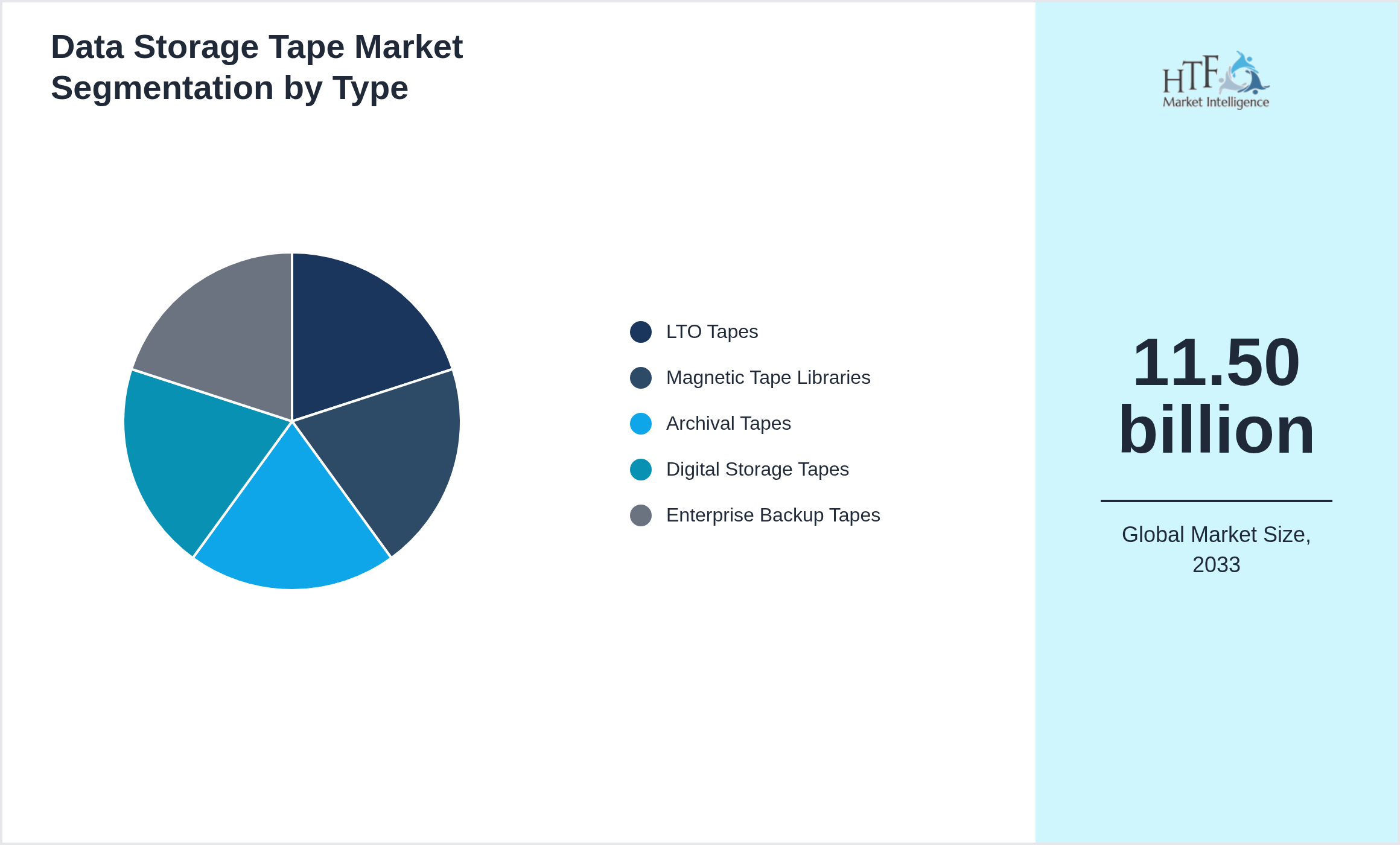
- • LTO Tapes
- • Magnetic Tape Libraries
- • Archival Tapes
- • Digital Storage Tapes
- • Enterprise Backup Tapes
Segmentation by Application
- • Data Centers
- • Cloud Backup
- • Archival Storage
- • Banking Systems
- • Government Records
![Data Storage Tape Market trend by end use applications [Data Centers, Cloud Backup, Archival Storage, Banking Systems, Government Records]](https://htf-insight.s3.us-east-1.amazonaws.com/generated-charts/chart-pie-and-donut-chart-application-4438219-na-1778701562866-1778701566311-7242d0478b3e6015.png)
Key Players
The companies highlighted in this profile were selected based on insights from primary experts and an evaluation of their market penetration, product offerings, and geographical reach:
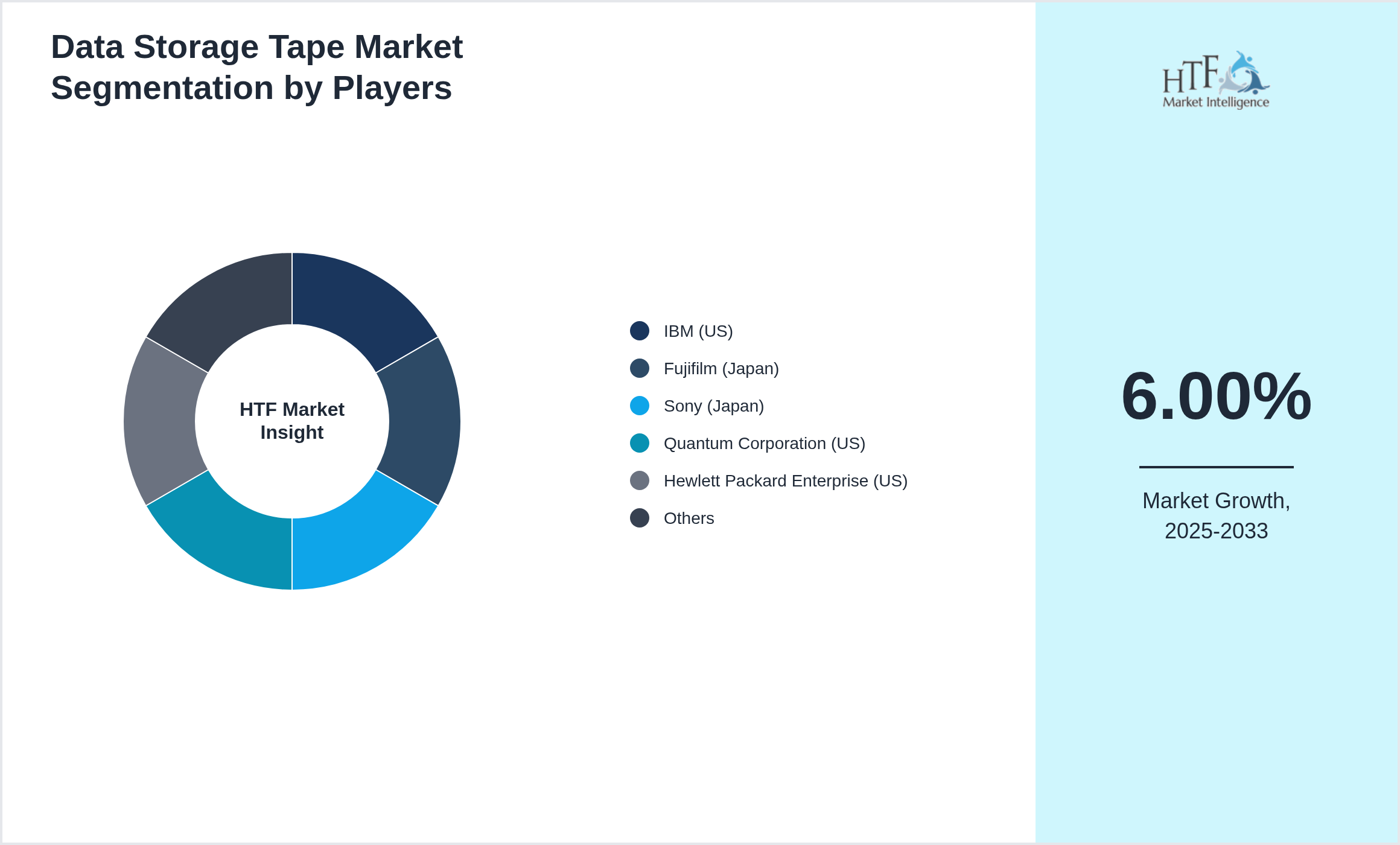
- • IBM (US)
- • Fujifilm (Japan)
- • Sony (Japan)
- • Quantum Corporation (US)
- • Hewlett Packard Enterprise (US)
- • Oracle (US)
- • Dell Technologies (US)
- • Hitachi (Japan)
- • Seagate (US)
- • Western Digital (US)
- • Spectra Logic (US)
- • Lenovo (China)
- • Huawei (China)
- • NEC (Japan)
- • Toshiba (Japan)
- • Panasas (US)
- • StorageTek (US)
- • NetApp (US)
- • Tandberg Data (Norway)
- • Overland Storage (US)
Regional Outlook
The Asia Pacific is the fastest-growing region due to its rapidly increasing population and expanding economic activities across various industries. This growth is further fueled by rising urbanization, improving infrastructure, and government initiatives aimed at fostering industrial development. Additionally, the region's young and dynamic workforce, along with an increase in consumer spending, contributes significantly to its accelerated growth rate. The North America is the dominating region and is going to maintain its dominance during the forecasted period.
- North America
- LATAM
- West Europe
- Central & Eastern Europe
- Northern Europe
- Southern Europe
- East Asia
- Southeast Asia
- South Asia
- Central Asia
- Oceania
- MEA
Among the major investors, Johnson & Johnson is a prominent player. The company consistently allocates significant resources to expand its research capabilities, develop new medical technologies, and enhance its pharmaceutical portfolio. Johnson & Johnson's investments in R&D, coupled with strategic acquisitions and partnerships, reinforce its position as a major contributor to advancements in healthcare. This focus on innovation and market expansion underscores the critical importance of the North American region in the global healthcare landscape.
Source: HTF Market Intelligence (HTF MI)
For the complete company list, please ask for sample pages.
Competitive Landscape
The competitive landscape of the market provides a comprehensive analysis of the key players and their market positioning. It identifies the leading companies, including both established firms and emerging competitors, outlining their strengths such as innovation, strong brand presence, and extensive customer base, as well as weaknesses like limited product range or geographic reach. This section also delves into how these competitors position themselves in the market, whether they target premium, mid-tier, or budget segments, and how they differentiate from others through pricing, product innovation, or customer service.
Additionally, it highlights significant strategic moves, such as mergers, acquisitions, or product launches, that have impacted their competitive standing. The role of technology and innovation is another key factor, with companies investing in research and development to stay ahead. By understanding this competitive landscape, businesses can better identify market opportunities, anticipate competitor strategies, and adjust their approaches to gain a stronger foothold.
Research Methodology & Data Triangulation
Data triangulation is a robust research method that enhances the credibility and validity of findings by combining multiple data sources, methodologies, or perspectives. This approach involves three primary types: data source triangulation, where information is gathered from different sources such as surveys, interviews, and secondary data; methodological triangulation, which integrates various research methods, such as qualitative and quantitative techniques, to enrich the analysis; and investigator triangulation, where multiple researchers collaborate to interpret data, minimizing individual bias.
By employing data triangulation, businesses can gain a more comprehensive understanding of market dynamics and consumer behavior. This method helps validate findings by cross-referencing information, ensuring that conclusions are not based on a single data point. Consequently, triangulation enhances decision-making processes, as organizations can rely on more accurate and reliable insights. Ultimately, this approach fosters confidence in strategic planning and contributes to more effective risk management and resource allocation.
Key Development Activities
Market Entropy
- • In 2024: Enterprise data archiving globally increased data storage tape demand.
- • Cloud backup diversification strengthened applications.
- • In 2025: High-capacity magnetic storage technologies improved efficiency.
- • Data center expansion strengthened adoption.
- • In 2026: Mature global data storage markets stabilized tape storage procurement cycles.
- • Jan 2024: Fujifilm acquired TapeArchive Systems to expand enterprise data storage tape technologies globally.
- • Sep 2024: IBM partnered with SecureData Labs to integrate long-term archival solutions.
- • Feb 2025: Sony merged with HighDensity Storage Technologies to strengthen cloud and enterprise storage portfolios.
- • Patent activity focuses on magnetic media densitytape durabilityautomated tape librariescompression algorithmsarchival reliabilitylow-energy storage systemsand advanced read-write head technologies. Japan and North America lead patents related to high-capacity enterprise storage tapes. Europe contributes innovations in archival preservation and enterprise automation. Asia-Pacific companies increasingly file patents around scalable data center storage systems and cloud-integrated tape infrastructure. Innovation also targets AI-assisted storage management and energy-efficient archival systems.
- • Investment is driven by hyperscale cloud growthenterprise backup modernizationcybersecurity resilienceand long-term archival requirements. North America attracts significant investments from cloud providers and enterprise storage companies. Asia-Pacific funding accelerates through data center expansion and digital infrastructure projects. Europe supports secure archival storage and government-backed digital preservation initiatives. Organizations continue investing in hybrid cloud architectures integrating tape systems for low-costlong-termand energy-efficient data retention strategies globally.
Market Estimation Process
Report Details
| Report Features | Details |
| Base Year | 2025 |
| Based Year Market Size (2025) | 7.20 billion |
| Historical Period | 2021 to 2025 |
| CAGR (2025 to 2033) | 6.00% |
| Forecast Period | 2026 to 2033 |
| Forecasted Period Market Size (2033) | 11.50 billion |
| Scope of the Report | LTO Tapes, Magnetic Tape Libraries, Archival Tapes, Digital Storage Tapes, Enterprise Backup Tapes, Data Centers, Cloud Backup, Archival Storage, Banking Systems, Government Records |
| Regions Covered | North America, LATAM, West Europe, Central & Eastern Europe, Northern Europe, Southern Europe, East Asia, Southeast Asia, South Asia, Central Asia, Oceania, MEA |
| Companies Covered | IBM (US), Fujifilm (Japan), Sony (Japan), Quantum Corporation (US), Hewlett Packard Enterprise (US), Oracle (US), Dell Technologies (US), Hitachi (Japan), Seagate (US), Western Digital (US), Spectra Logic (US), Lenovo (China), Huawei (China), NEC (Japan), Toshiba (Japan), Panasas (US), StorageTek (US), NetApp (US), Tandberg Data (Norway), Overland Storage (US) |
| Customization Scope | 15% Free Customization |
| Delivery Format | PDF and Excel through Email |
Limitation & Assumptions
Limitations and assumptions in a market research report are critical for framing the context and reliability of the findings. Limitations refer to potential weaknesses or constraints that may impact the research outcomes. These can include a limited sample size, which may not represent the broader population, or reliance on self-reported data, which can introduce bias. Other limitations may involve geographical constraints, where findings may not be applicable outside the studied regions, or temporal factors, such as rapidly changing market conditions, that can render results less relevant over time.
Assumptions are foundational beliefs taken for granted in the research process. For instance, it may be assumed that respondents provided honest and accurate information or that market conditions remained stable during the research period. Acknowledging these limitations and assumptions helps stakeholders critically evaluate the validity of the report's conclusions and guides strategic decisions based on the inherent uncertainties of the research.