
English Language Training (ELT) Market - Europe Share, Size & Changing Dynamics 2021-2034
Europe English Language Training (ELT) Market is segmented by Application (Schools, Universities, Corporate Training, Individual Learners, Government Programs), Type (Online ELT, Classroom ELT, Blended ELT, Corporate ELT, Academic ELT), and Geography (Germany, France, The United Kingdom, BeNeLux, Spain, Italy, NORDIC, CEE, Others)
Pricing
Report Overview
Industry Overview
The English Language Training (ELT) market is expected to reach 31.8 billion by 2034 and is growing at a CAGR of10.80% between 2025 and 2034.
The Europe English Language Training (ELT) Market comprises educational programs, digital learning platforms, training services, and language proficiency solutions focused on improving English communication skills among students, professionals, and academic learners. The market includes classroom-based instruction, online language learning platforms, mobile learning applications, corporate training programs, test preparation services, AI-enabled tutoring systems, and blended learning environments. The scope covers academic ELT, professional communication training, K-12 language education, higher education language programs, and enterprise learning solutions, while excluding non-English language instruction and informal self-learning resources without structured training frameworks. Market growth is supported by globalization, international workforce mobility, and increasing demand for English proficiency in higher education and business communication. Demand-side dynamics are influenced by study-abroad trends, multinational employment requirements, and digital learning adoption. Supply-side transformation is driven by edtech innovation, subscription-based learning platforms, and AI-powered personalized education systems. Technological evolution includes adaptive learning algorithms, speech recognition-based pronunciation assessment, virtual classrooms, and gamified language training ecosystems
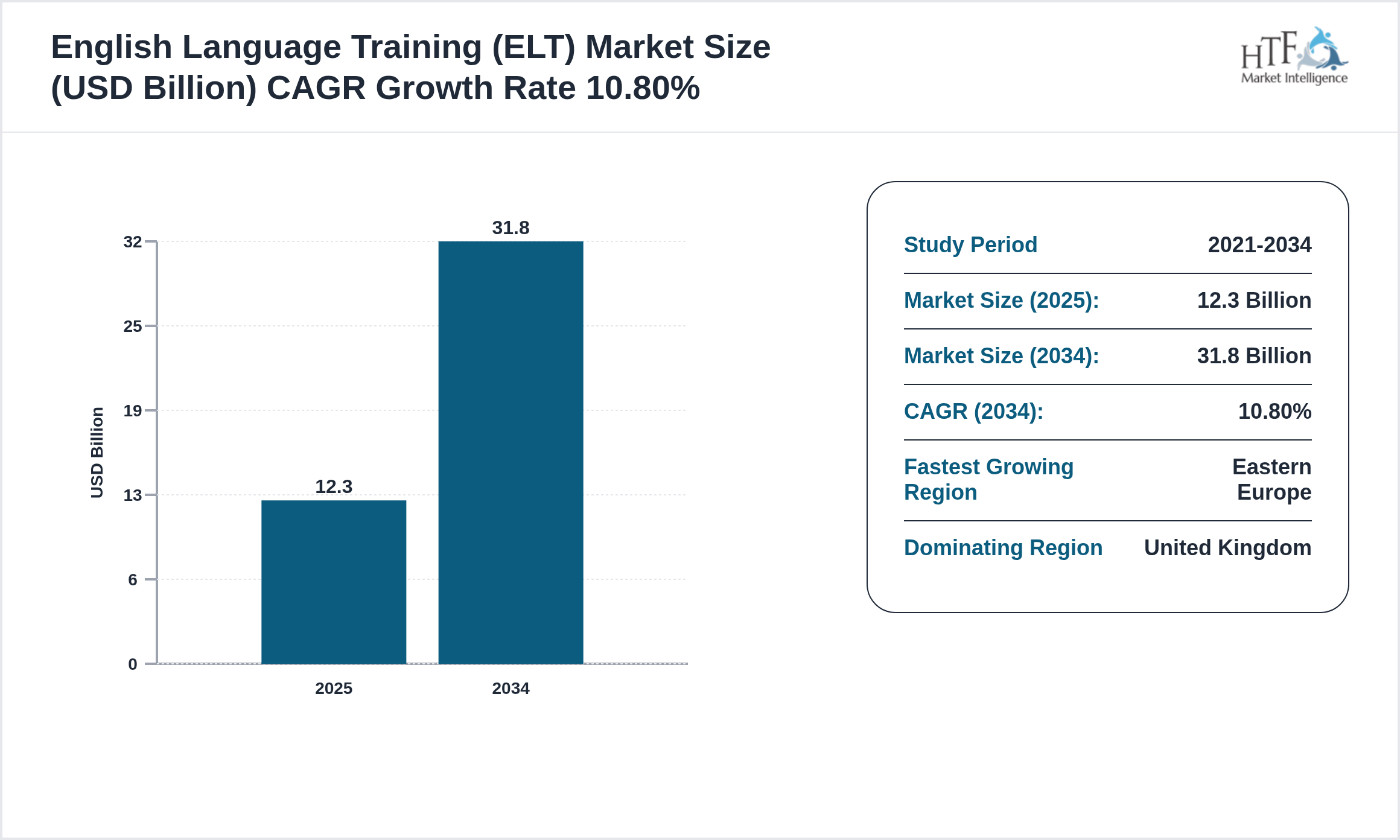
Source: HTF Market Intelligence (HTF MI)
Market Size & Forecast
Market Segmentation
Selecting segmentation criteria in Pearson plc (United Kingdom), Berlitz Corporation (United States), EF Education First (Switzerland), Cambridge University Press (United Kingdom), Sanako Corporation (Finland), Rosetta Stone Inc. (United States), Linguaphone Group (United Kingdom), Houghton Mifflin Harcourt (United States), Macmillan Education (United Kingdom), Wall Street English (Luxembourg), Inlingua International (Switzerland), Learnship Networks (Germany), Babbel GmbH (Germany), Duolingo Inc. (United States), Oxford University Press (United Kingdom) involves several key steps. Researchers begin by defining their objectives, such as understanding consumer behavior or identifying market opportunities. They then gather relevant data on demographics, psychographics, and buying behavior. Next, they identify segmentation variables like age, location, lifestyle, and purchase patterns. Using analytical tools, they analyze the data to find distinct market segments and evaluate their attractiveness based on size, growth potential, and alignment with business goals. Detailed profiles are created for each segment, and the most promising ones are selected for targeting. Finally, tailored marketing strategies are developed, and the performance of these strategies is monitored and adjusted as needed. This process ensures that segmentation effectively identifies valuable market opportunities and aligns with strategic goals.
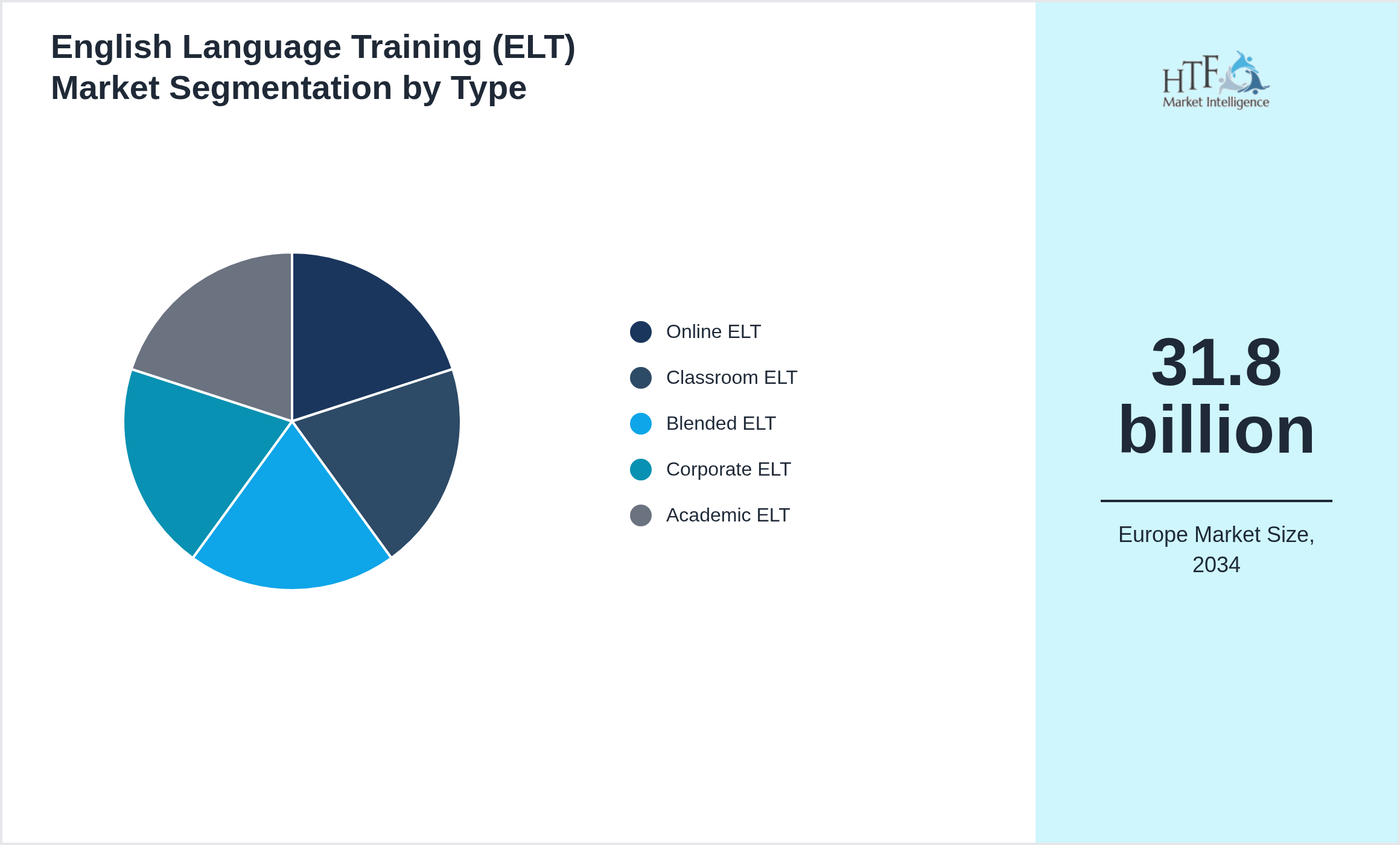
Segmentation by Type
- • Online ELT
- • Classroom ELT
- • Blended ELT
- • Corporate ELT
- • Academic ELT
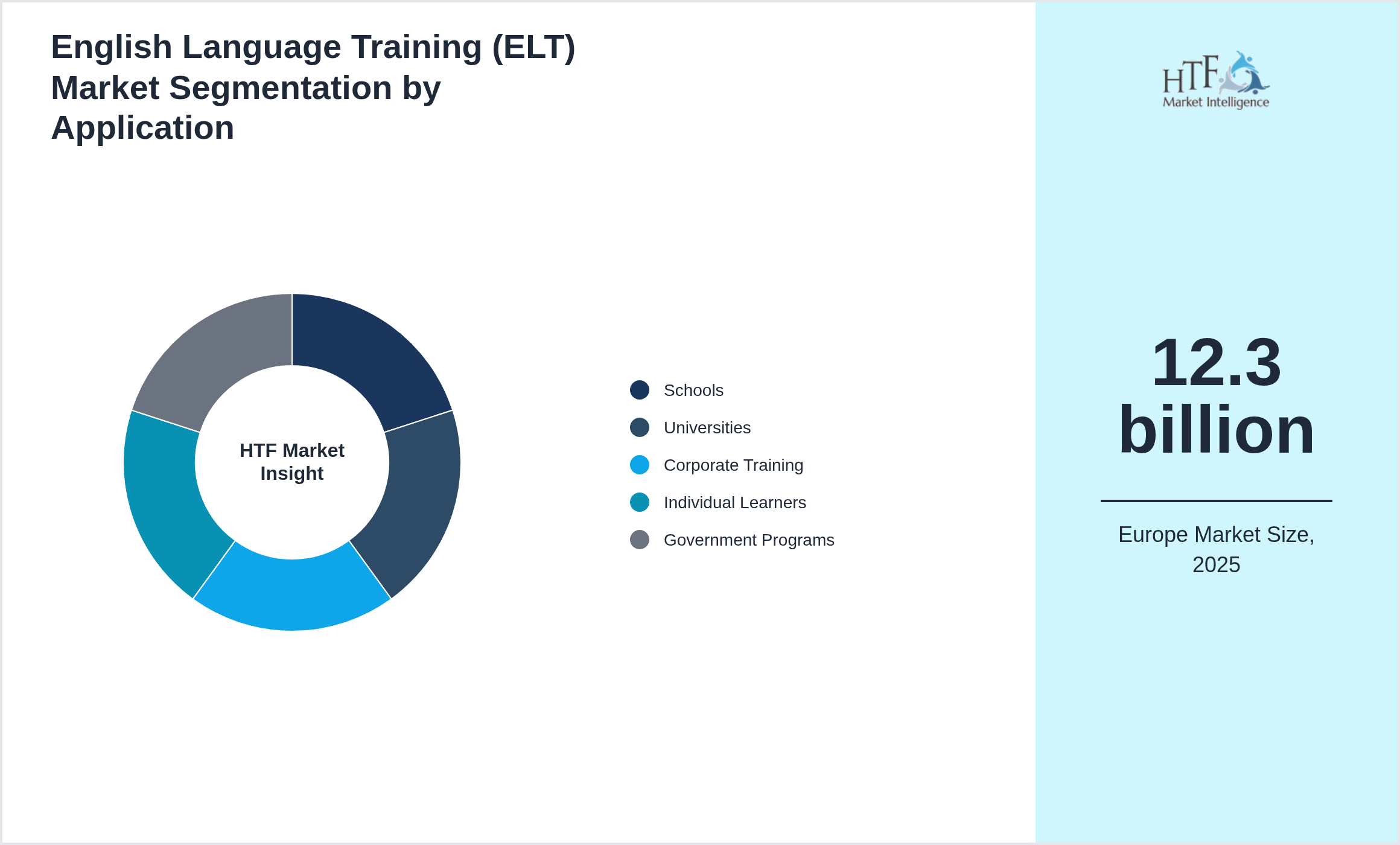
Segmentation by Application
- • Schools
- • Universities
- • Corporate Training
- • Individual Learners
- • Government Programs
English Language Training (ELT) Market Dynamics
TheEnglish Language Training (ELT) is driven by factors such as increasing demand in end-use industries, technological advancements, research and development (R&D), economic growth, and increasing global trade.
Influencing Trend:
- • The market is witnessing rapid adoption of AI-powered language learning platforms virtual classrooms and gamified educational technologies. Personalized learning systems using adaptive analytics are becoming increasingly common within ELT programs. Mobile-based microlearning and blended learning models integrating online and classroom instruction are gaining strong popularity. Corporate English training focused on industry-specific communication skills is also emerging as a major trend. Integration of speech recognition immersive learning environments and multilingual collaboration tools is reshaping the European ELT ecosystem
- • The Europe English Language Training (ELT) market is growing due to increasing globalization international student mobility and rising demand for English proficiency across corporate and academic sectors. Educational institutions and employers are prioritizing English communication skills to improve workforce competitiveness and cross-border collaboration. Growth in digital learning platforms and remote education technologies is expanding access to language training services. Immigration and international workforce mobility within Europe are also contributing to demand growth. Businesses are increasingly investing in professional English training programs to support multinational operations and customer engagement across global markets
- • The market faces challenges related to pricing pressure from free digital learning applications and intense competition among language training providers. Economic uncertainty and budget limitations within educational institutions can affect spending on language programs. Maintaining learner engagement and measuring language proficiency outcomes across online platforms remains difficult for providers. Variations in educational regulations and certification standards across European countries create operational complexity. Shortage of qualified language instructors and technological disparities in digital learning infrastructure also affect the scalability and effectiveness of English language training programs
- • Significant opportunities exist in online education platforms corporate workforce development programs and English certification training services across Europe. Expansion of remote work and international outsourcing increases demand for professional communication skills training. Educational technology providers are developing AI-enabled tutoring and conversational language learning applications targeting schools and adult learners. Government-funded language integration programs for migrants and international students also create additional market potential. Growth in hybrid education models and cross-border digital learning ecosystems offers strong long-term opportunities for ELT providers and educational content developers
Regional Insight
The United Kingdomregion holds a dominant market share, primarily driven by growing consumption patterns, a rising population, and robust economic activity that fuels market demand. Meanwhile, the Eastern Europe Region is experiencing the fastest growth, propelled by increasing infrastructure developments, expanding industrial activities, and a surge in consumer demand, positioning it as a key driver for future market expansion.
- Germany
- France
- The United Kingdom
- BeNeLux
- Spain
- Italy
- NORDIC
- CEE
- Others
- • Europe English Language Training (ELT) market is expanding steadily due to increasing international student mobility cross-border corporate communication requirements and growing migration-driven language learning demand. Countries including Germany France Spain and Italy are witnessing strong enrollment growth in digital and classroom-based ELT programs. Educational institutions and enterprises increasingly adopt AI-powered learning platforms virtual tutoring systems and blended learning models to improve language proficiency outcomes. Government-supported workforce development initiatives and international business expansion continue strengthening demand for professional English communication skills. Rising preference for online certification programs and mobile-based learning applications creates significant commercial opportunities for digital ELT providers throughout Europe
Key Players
The companies highlighted in this profile were selected based on insights from primary experts and an evaluation of their market penetration, product offerings, and geographical reach:
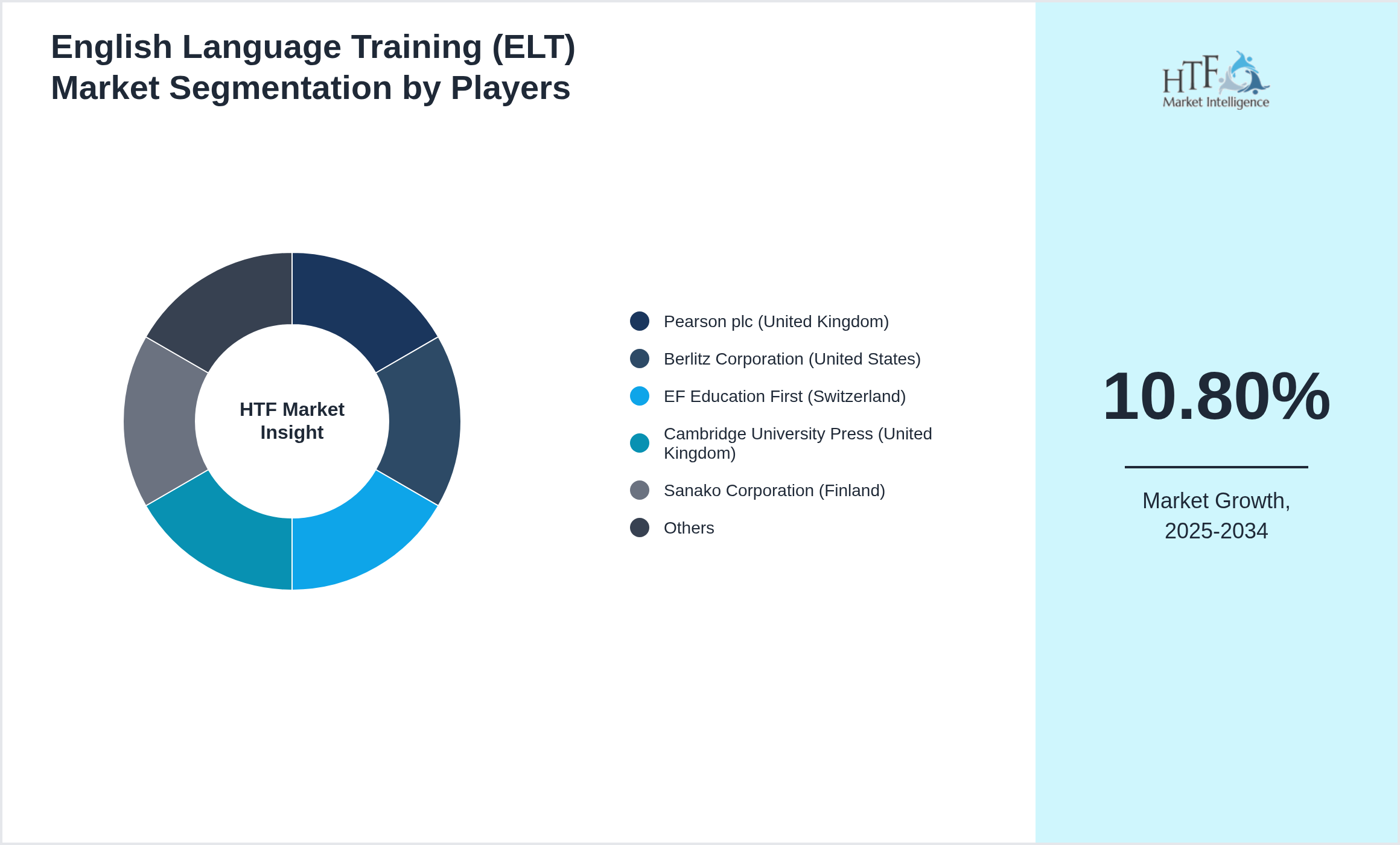
- • Pearson plc (United Kingdom)
- • Berlitz Corporation (United States)
- • EF Education First (Switzerland)
- • Cambridge University Press (United Kingdom)
- • Sanako Corporation (Finland)
- • Rosetta Stone Inc. (United States)
- • Linguaphone Group (United Kingdom)
- • Houghton Mifflin Harcourt (United States)
- • Macmillan Education (United Kingdom)
- • Wall Street English (Luxembourg)
- • Inlingua International (Switzerland)
- • Learnship Networks (Germany)
- • Babbel GmbH (Germany)
- • Duolingo Inc. (United States)
- • Oxford University Press (United Kingdom)
Regulatory Framework
The regulatory framework for the English Language Training (ELT) ensures product safety, fair competition, and consumer protection. It encompasses setting standards for product quality and safety, enforcing truthful advertising and labeling, and implementing environmental sustainability practices. Regulations include robust procedures for product recalls, data protection, and anti-competitive practices, while also overseeing import/export controls and intellectual property rights. Regulatory bodies enforce these rules through inspections and penalties, and consumer education programs help individuals make informed decisions. This framework aims to protect consumers, promote fair market conditions, and encourage ethical business practices.
- • The European English Language Training (ELT) market is regulated through education quality standards student visa policies accreditation frameworks and digital learning compliance requirements. Governments and educational institutions increasingly require certified curriculum standards instructor qualifications and online learning platform security compliance to support academic and professional language training programs. Immigration policies and international student mobility regulations significantly influence enrollment demand across major European education hubs. Expansion of digital education infrastructure and hybrid learning models is accelerating adoption of AI-enabled language learning platforms. Rising operational costs linked to faculty wages digital content development and regulatory accreditation continue impacting institutional profitability. Regulatory emphasis on educational quality assurance and cross-border recognition strengthens long-term market stability for accredited ELT providers
Competitive Insights
The key players in the English Language Training (ELT) are intensifying their focus on research and development (R&D) activities to innovate and stay competitive. Major companies, such as Pearson plc (United Kingdom), Berlitz Corporation (United States), EF Education First (Switzerland), Cambridge University Press (United Kingdom), Sanako Corporation (Finland), Rosetta Stone Inc. (United States), Linguaphone Group (United Kingdom), Houghton Mifflin Harcourt (United States), Macmillan Education (United Kingdom), Wall Street English (Luxembourg), Inlingua International (Switzerland), Learnship Networks (Germany), Babbel GmbH (Germany), Duolingo Inc. (United States), Oxford University Press (United Kingdom), are heavily investing in R&D to develop new products and improve existing ones. This strategic emphasis on innovation is driving significant advancements in product formulation and the introduction of sustainable and eco-friendly products.
In addition to R&D and acquisitions, there is a notable shift towards green investments among key players in the consumer goods industry. Companies are increasingly committing resources to sustainable practices and the development of environmentally friendly products. This green investment is in response to growing consumer demand for sustainable solutions and stringent environmental regulations. By prioritizing sustainability, these companies are not only contributing to environmental protection but also positioning themselves as leaders in the green movement, thereby fueling market growth.
Merger Acquisition
Patent Analysis
- • Companies in the Europe English Language Training (ELT) market are actively protecting patents associated with AI-based language learning engines speech recognition systems adaptive assessment technologies and virtual learning platforms. Education technology firms are registering trademarks for online language training applications certification programs and digital classroom ecosystems to improve institutional visibility. Copyright activity is expanding around digital educational content e-learning modules interactive assessment software and multilingual training databases as online education adoption continues to rise across Europe
Investment and Funding Scenario
- • The Europe English Language Training (ELT) market is witnessing growing investment from edtech firms institutional investors and digital learning platform providers due to rising international workforce mobility and online education demand. Companies are securing venture funding for AI-powered language assessment tools virtual classrooms and adaptive learning technologies. Strategic acquisitions of digital tutoring startups and content development companies are strengthening multilingual learning portfolios. Educational organizations are also forming joint ventures with technology firms to expand blended learning ecosystems across schools and corporate training environments. Several ELT providers are receiving expansion financing to support subscription-based e-learning infrastructure and mobile-first language training applications
Market Entropy
- • Q4 2025: ELT providers introduced AI-powered adaptive learning platforms and immersive virtual classroom systems that improved learner engagement and course completion rates by approximately 28%. Commercial scalability accelerated through subscription-based digital language ecosystems and enterprise learning partnerships. Strategic investments strengthened multilingual e-learning infrastructure across Europe
- • Q3 2025: Industry-wide operational shifts toward hybrid education models increased deployment of cloud-based language assessment and personalized learning analytics platforms. Supply-chain modernization improved accessibility to digital education devices and collaborative learning technologies. Sustainability milestones included reduced physical material consumption through digital-first education delivery
- • Q2 2025: Production modernization initiatives integrated speech recognition AI tutoring and predictive learner performance analytics into ELT platforms improving educational efficiency and learner retention. Regulatory modernization strengthened online education accreditation and digital privacy standards. Digital transformation initiatives accelerated cross-border virtual education expansion
- • Q1 2025: Educational institutions and training providers modernized language learning infrastructure using cloud-based collaboration tools and intelligent content delivery systems improving accessibility and operational scalability across academic and corporate training environments
Report Infographics:
| Report Features | Details |
| Base Year | 2025 |
| Based Year Market Size 2025 | 12.3 billion |
| Historical Period Market Size 2021 | USD Million ZZ |
| CAGR (2025 to 2034) | 10.80% |
| Forecast Period | 2025 to2034 |
| Forecasted Period Market Size 2034 | 31.8 billion |
| Scope of the Report | Online ELT, Classroom ELT, Blended ELT, Corporate ELT, Academic ELT, Schools, Universities, Corporate Training, Individual Learners, Government Programs |
| Regions Covered | Germany, France, The United Kingdom, BeNeLux, Spain, Italy, NORDIC, CEE, Others |
| Year-on-Year Growth | 9.20% |
| Companies Covered | Pearson plc (United Kingdom), Berlitz Corporation (United States), EF Education First (Switzerland), Cambridge University Press (United Kingdom), Sanako Corporation (Finland), Rosetta Stone Inc. (United States), Linguaphone Group (United Kingdom), Houghton Mifflin Harcourt (United States), Macmillan Education (United Kingdom), Wall Street English (Luxembourg), Inlingua International (Switzerland), Learnship Networks (Germany), Babbel GmbH (Germany), Duolingo Inc. (United States), Oxford University Press (United Kingdom) |
| Customization Scope | 15% Free Customization (For EG) |
| Delivery Format | PDF and Excel through Email
Want to Buy Specific Sections of This Report?
|
Research Methodology
The research methodology for the consumer goods industry involves several key steps to ensure comprehensive and actionable insights. First, the research objectives are clearly defined, focusing on aspects like consumer behavior, market opportunities, competitive dynamics, or regulatory impacts. A thorough literature review follows, drawing from academic journals, industry reports, government publications, and market analyses to establish a knowledge base and identify research gaps. Data collection encompasses both primary methods, such as surveys, interviews, and focus groups with consumers and industry experts, and secondary methods, including analysis of market reports, government data, and industry publications. Quantitative data is analyzed using statistical tools to identify patterns and market segments, while qualitative data from interviews and focus groups is examined to extract key themes and insights.
The market is then segmented based on demographics, psychographics, geography, and purchasing behavior, and competitive analysis is conducted to evaluate key players' strategies and strengths. Trend analysis identifies current and emerging industry trends. Findings are compiled into a detailed report with data visualizations and strategic recommendations. The research is validated and refined through cross-checking and expert feedback, and a framework for continuous monitoring is established to keep the research current and relevant.