
Stationary Gas Compressors Market - Europe Size & Outlook 2021-2034
Europe Stationary Gas Compressors Market is segmented by Application (Chemical Processing, Oil & Gas, Power Generation, Manufacturing, Food & Beverage), Type (Reciprocating, Screw, Centrifugal), and Geography (Germany, France, The United Kingdom, BeNeLux, Spain, Italy, NORDIC, CEE, Others)
Pricing
Report Overview
Industry Overview
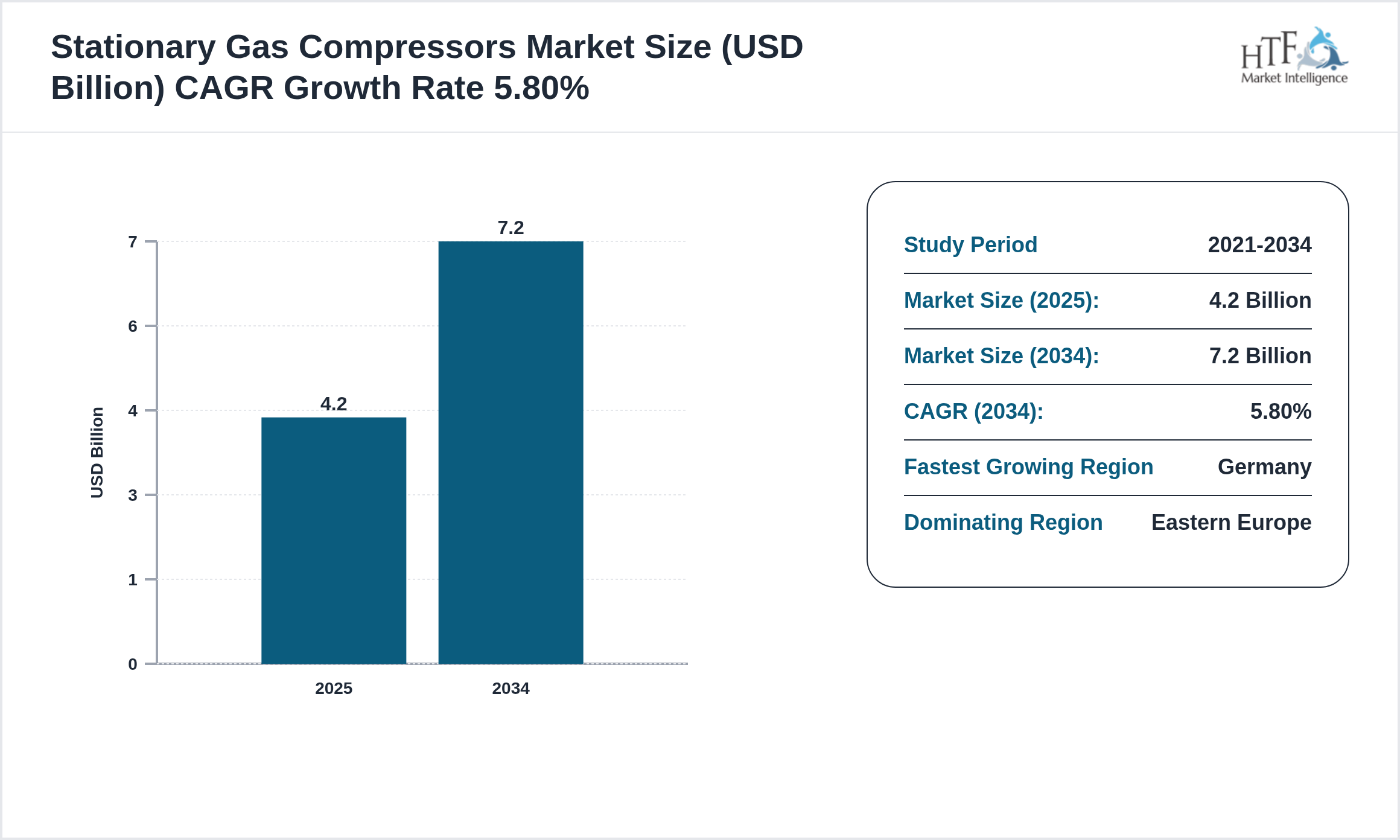
The Stationary Gas Compressors is at 4.2 billion in 2025 and is expected to reach usd 7.2 billion by 2034. The Stationary Gas Compressors is driven by factors such as increasing demand in end-use industries, technological advancements, research and development (R&D), economic growth, and increasing global trade. Atlas Copco AB (Sweden), Ingersoll Rand Inc. (United States), Siemens AG (Germany), MAN Energy Solutions (Germany), Gardner Denver Holdings (United States), Kaeser Kompressoren SE (Germany), Kobelco Compressors (Japan), Hitachi Industrial Equipment Systems (Japan), Howden Group Ltd. (United Kingdom), BOGE Compressors (Germany), ELGi Equipments Ltd. (India), Shanghai Electric Group (China), Denair Compressor (Germany), Sullair LLC (United States), Quincy Compressor (United States) and others are some of the key players in the market.
The Europe Stationary Gas Compressors Market refers to mechanical devices used to compress gases for storage, transport, and process applications in industrial, petrochemical, and energy sectors. It includes reciprocating, centrifugal, and rotary compressors, along with associated control and monitoring systems. The scope covers installation, maintenance, and aftermarket services while excluding portable compressors and compressors for non-industrial applications. Growth is supported by increasing industrial gas demand, energy efficiency regulations, and expansion of natural gas infrastructure. Demand-side dynamics involve continuous supply requirements, energy optimization, and environmental compliance, while supply-side transformation is characterized by advanced materials, smart monitoring systems, and energy-efficient designs. Technological evolution includes variable speed drives, IoT-enabled monitoring, predictive diagnostics, and low-emission compressor technologies
Source: HTF Market Intelligence (HTF MI)
Key Players
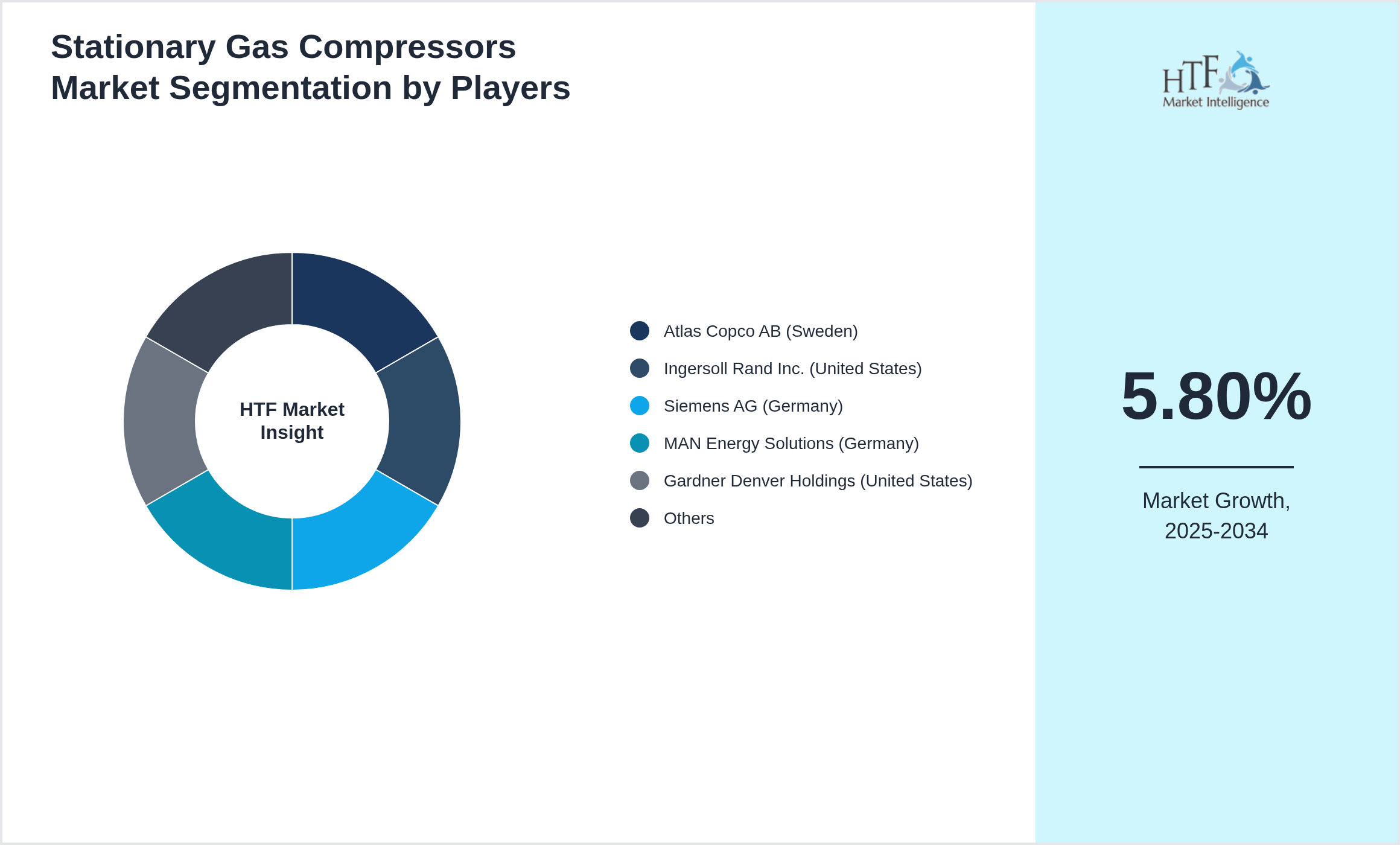
Several key players in the Stationary Gas Compressors market are strategically focusing on expanding their operations in developing regions to capture a larger market share, particularly as the year-on-year growth rate for the market stands at 5.00%. The companies featured in this profile were selected based on insights from primary experts, evaluating their market penetration, product offerings, and geographical reach.
- • Atlas Copco AB (Sweden)
- • Ingersoll Rand Inc. (United States)
- • Siemens AG (Germany)
- • MAN Energy Solutions (Germany)
- • Gardner Denver Holdings (United States)
- • Kaeser Kompressoren SE (Germany)
- • Kobelco Compressors (Japan)
- • Hitachi Industrial Equipment Systems (Japan)
- • Howden Group Ltd. (United Kingdom)
- • BOGE Compressors (Germany)
- • ELGi Equipments Ltd. (India)
- • Shanghai Electric Group (China)
- • Denair Compressor (Germany)
- • Sullair LLC (United States)
- • Quincy Compressor (United States)
Stationary Gas Compressors Market Dynamics Highlights
Key Highlights
- The Stationary Gas Compressors is growing at a 5.80% during the forecasted period of 2021 to 2034
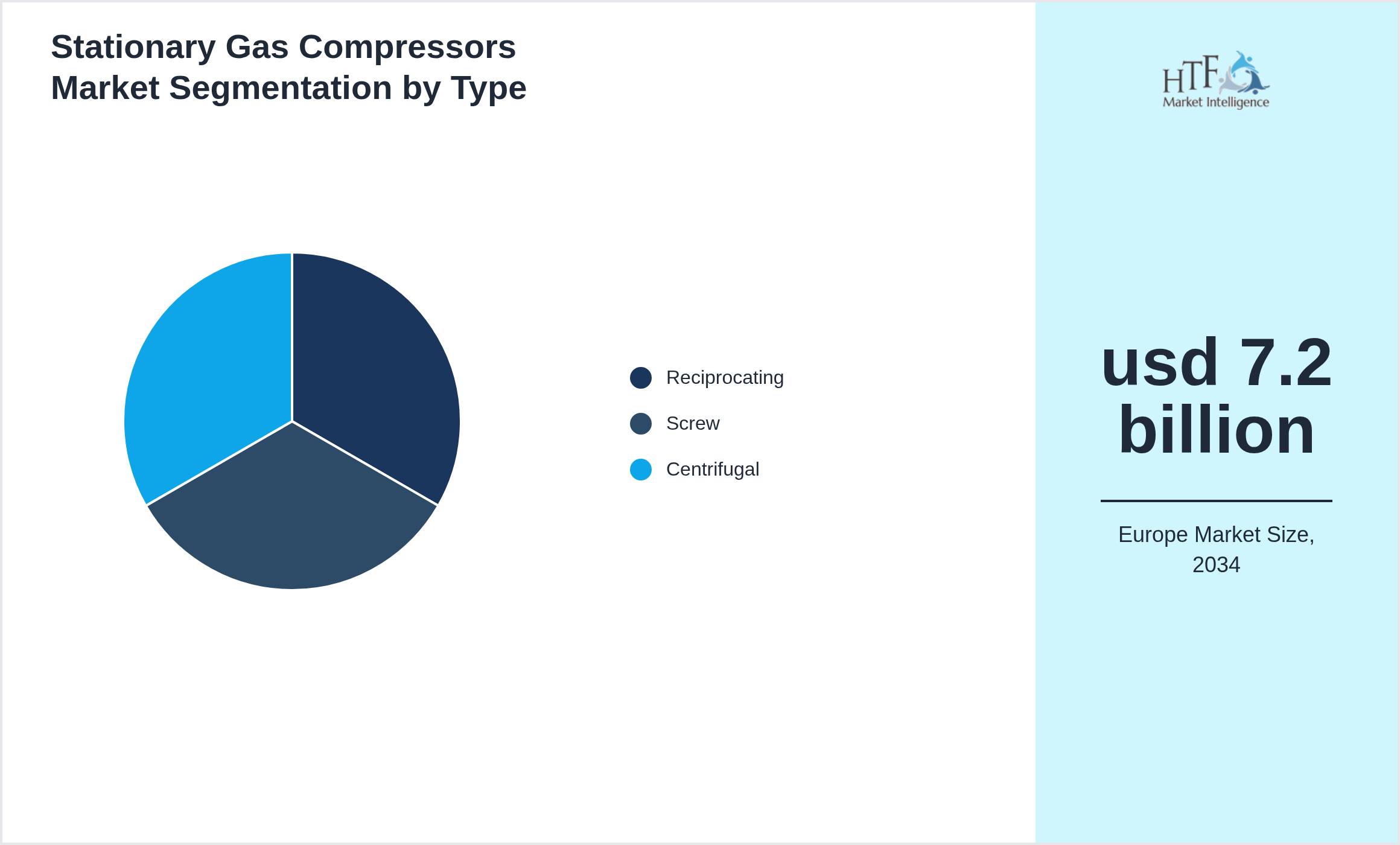
- Based on type, the market is bifurcated into Reciprocating, Screw, Centrifugal
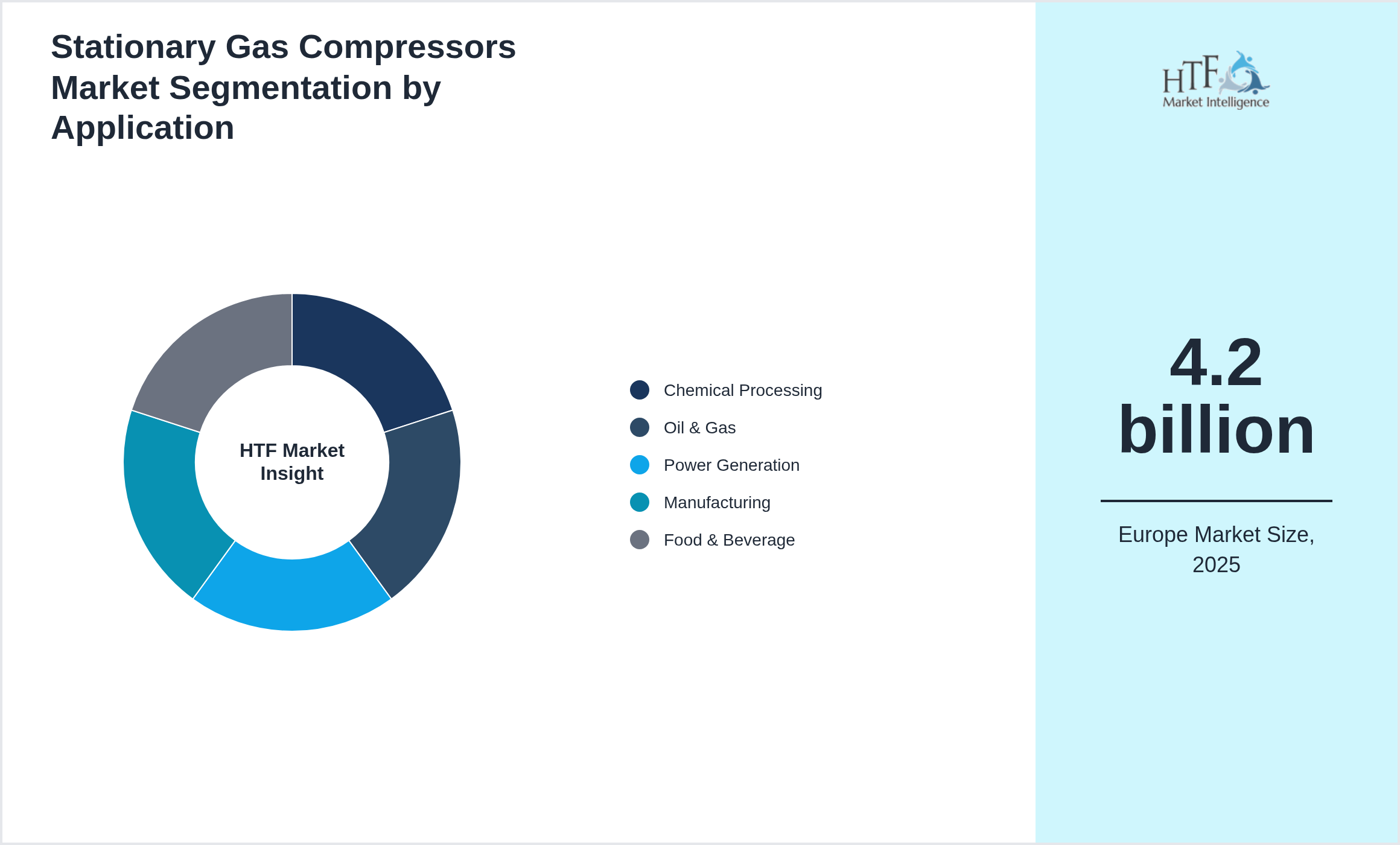
- Based on application, the market is segmented into Chemical Processing, Oil & Gas, Power Generation, Manufacturing, Food & Beverage
- Global import/export in terms of K tons, K units, and metric tons will be provided if applicable based on industry best practices.
Market Segmentation Overview
- Type Segmentation: categorizes products by their specific variants, helping businesses identify demand drivers and innovate effectively.
- Application Segmentation: Divides the market based on product usage across industries, enabling targeted marketing and growth identification.
- Geographic Segmentation: Segments the market by location, allowing for tailored strategies based on regional preferences and economic factors.
- Customer Segmentation: Focuses on demographics like age, gender, and income, enabling personalized marketing and improved customer targeting.
- Distribution Channel Segmentation: categorizes how products reach customers, optimizing supply chain and sales strategies.
Market Segmentation
Segmentation by Type
- • Reciprocating
- • Screw
- • Centrifugal
Segmentation by Application
- • Chemical Processing
- • Oil & Gas
- • Power Generation
- • Manufacturing
- • Food & Beverage
Understand Key Market Dynamics
Regional Analysis
- Germany
- France
- The United Kingdom
- BeNeLux
- Spain
- Italy
- NORDIC
- CEE
- Others
Market Entropy
- • Q4 2025: Technological breakthroughs included high-efficiency rotary and reciprocating compressors
Merger & Acquisition
- • Jan 2024: Atlas Copco acquired EuroCompress Systems to expand stationary gas compressors in Europe.
- • Sep 2024: Ingersoll Rand partnered with GasFlow Labs to integrate energy-efficient solutions.
- • Feb 2025: Gardner Denver merged with IndustrialCompress Technologies to strengthen European industrial portfolios.
Regulatory Landscape
- • The European Stationary Gas Compressors market operates under EU Machinery Directive ATEX PED and CE marking compliance requirements ensuring safety in pressurized gas handling and hazardous environments. Emission limits and environmental regulations for industrial equipment impose stricter operational protocols and maintenance schedules. Cross-border trade restrictions and energy efficiency standards influence design and supply-chain decisions. Compliance with certification and inspection mandates raises operational costs but improves reliability customer trust and market scalability. Sustainability initiatives and carbon reduction policies are accelerating investment in energy-efficient compressor technologies positively impacting long-term profitability and production scalability
Patent Analysis
- • European stationary gas compressor manufacturers are increasingly patenting energy-efficient compression cycles low-noise designs and AI-enabled operational diagnostics. Trademarks are being registered for industrial compressor series maintenance service platforms and energy optimization solutions. Copyrights protect proprietary control software monitoring dashboards and predictive maintenance algorithms deployed across compressor systems
Investment and Funding Scenario
- • The European Stationary Gas Compressors market is seeing strong funding activity from industrial conglomerates energy infrastructure firms and private equity investors targeting efficiency improvements emission reduction and reliability enhancement. Startups and established manufacturers are receiving seed and growth financing for high-performance compressors AI-driven monitoring and predictive maintenance solutions. Several joint ventures and minority stake acquisitions with engineering service providers are enabling new deployment models across chemical LNG and power generation sectors. Loan-backed capital investments support technological modernization and European market expansion initiatives
Competitive Innovation Radar
- • The Europe Stationary Gas Compressors market is evolving through AI-integrated predictive maintenance platforms smart operational monitoring systems and automated process control technologies. Competition is centered on energy-efficient compressor designs IoT-enabled performance monitoring and digital traceability solutions capable of reducing downtime by over 25%. Smart monitoring systems precision engineering controls and automated resource optimization metrics are improving operational efficiency and production scalability. Sustainable productive technologies low-energy compressor systems and cloud-based performance analytics are further accelerating innovation cycles and operational reliability across industrial and energy sectors
Market Driver
Market Trends
Opportunity
Challenges
Primary & Secondary Approach
The Stationary Gas Compressors is analyzed by both primary and secondary research sources. There are numerous methodologies available to navigate and utilize these resources effectively:
Surveys and Questionnaires: Getting feedback from healthcare professionals, patients, or any other stakeholders on a particular topic. It is a great method to collect quantitative data on behaviors, preferences, and/or experiences.
One-on-ones: Interviews with key stakeholders, including physicians, nurses, and administrators, can yield rich qualitative data. The interviews can be divided into structured, semi-structured, or unstructured.
Focus Groups: Pull together small numbers of people who share a common characteristic, trait, or behavior to discuss particular topics. Focus Groups: This offers qualitative data and points of view that are often overlooked, such as attitudes, perceptions, or other statements relating to a specific platform.
Observational Studies: Understanding healthcare practices and patient interactions in the way we do it can say a lot more than what people formally report doing.
Field Studies: This method allows researchers to collect data firsthand from healthcare settings, including hospitals, clinics, and even homes. It is a way to touch and feel the context that drives service delivery in healthcare.
Secondary Research in Stationary Gas Compressors
Secondary research is a kind of revising, restructuring, and rethinking what has already been collected by primary sources. Such research is beneficial as long as it comes at a low cost and gives an overarching view of the market. Some of the important methods include:
Literature Review: To go through the research papers, articles, and studies published in medical journals, industry reports, and academic publications. This is crucial for understanding the study landscape and identifying knowledge deficits.
Reports From the Industry: It aims at examining reports published by market research firms, healthcare associations, and government bodies. This report can also be used by all stakeholders, including service providers and delivery chains across the world, to identify market opportunities in an undetermined depth.
Public Health Records: Data collected by governments and public health authorities in different countries of the world from organizations with global reach, like the CDC, WHO, or national departments. These are important because they provide us with epidemiological data and numbers.
Company Reports: Read the annual reports, financial statements, and press releases of healthcare companies. It includes company performance reports, market strategies, and competitive positioning for this domain.
Online Databases: You understand the access to databases like PubMed, MEDLINE, and even Google Scholar for scientific articles and study materials. Some of these databases are treasure troves for peer-reviewed data.
Media Sources: Analyzing news articles, press releases, and media coverage related to the healthcare industry. This helps in staying updated on recent developments and emerging trends.
A blended approach of primary and secondary research methods allows researchers to collect well-rounded, solid data that informs the best decisions and strategies.
Report Infographics:
| Report Features | Details |
| Base Year | 2025 |
| Based Year Market Size (2025) | 4.2 billion |
| Historical Period Market Size (2021) | USD Million ZZ |
| CAGR (2025 to 2034) | 5.80% |
| Forecast Period | 2026 to 2034 |
| Forecasted Period Market Size (2034) | usd 7.2 billion |
| Scope of the Report | Type, Application, Region |
| Quantitative Units |
Revenue in USD million/billion, volume in kilotons, and CAGR from 2025 to 2034 |
| Year-on-Year Growth | 5.00% |
| Companies Covered | Atlas Copco AB (Sweden), Ingersoll Rand Inc. (United States), Siemens AG (Germany), MAN Energy Solutions (Germany), Gardner Denver Holdings (United States), Kaeser Kompressoren SE (Germany), Kobelco Compressors (Japan), Hitachi Industrial Equipment Systems (Japan), Howden Group Ltd. (United Kingdom), BOGE Compressors (Germany), ELGi Equipments Ltd. (India), Shanghai Electric Group (China), Denair Compressor (Germany), Sullair LLC (United States), Quincy Compressor (United States) |
| Customization Scope | 15% Free Customization (For EG). Customized purchase options are available to match your specific research requirements |
| Delivery Format | PDF and Excel through Email |
Multidisciplinary researcher with 10+ years of experience uncovering insights across diverse domains focused on uncovering insights that drive informed decisions.