
Turning Centers Market - Apac Share, Size & Changing Dynamics 2021-2034
Apac Turning Centers Market is segmented by Application (Automotive, Aerospace, Energy, Electronics, General Manufacturing), Type (CNC Turning Center, Multi-Spindle Turning Center, Heavy-Duty Turning Center), and Geography (Japan, China, Southeast Asia, India, Australia, South Korea, Others)
Pricing
Report Overview
Key Values Provided by a Turning Centers Market
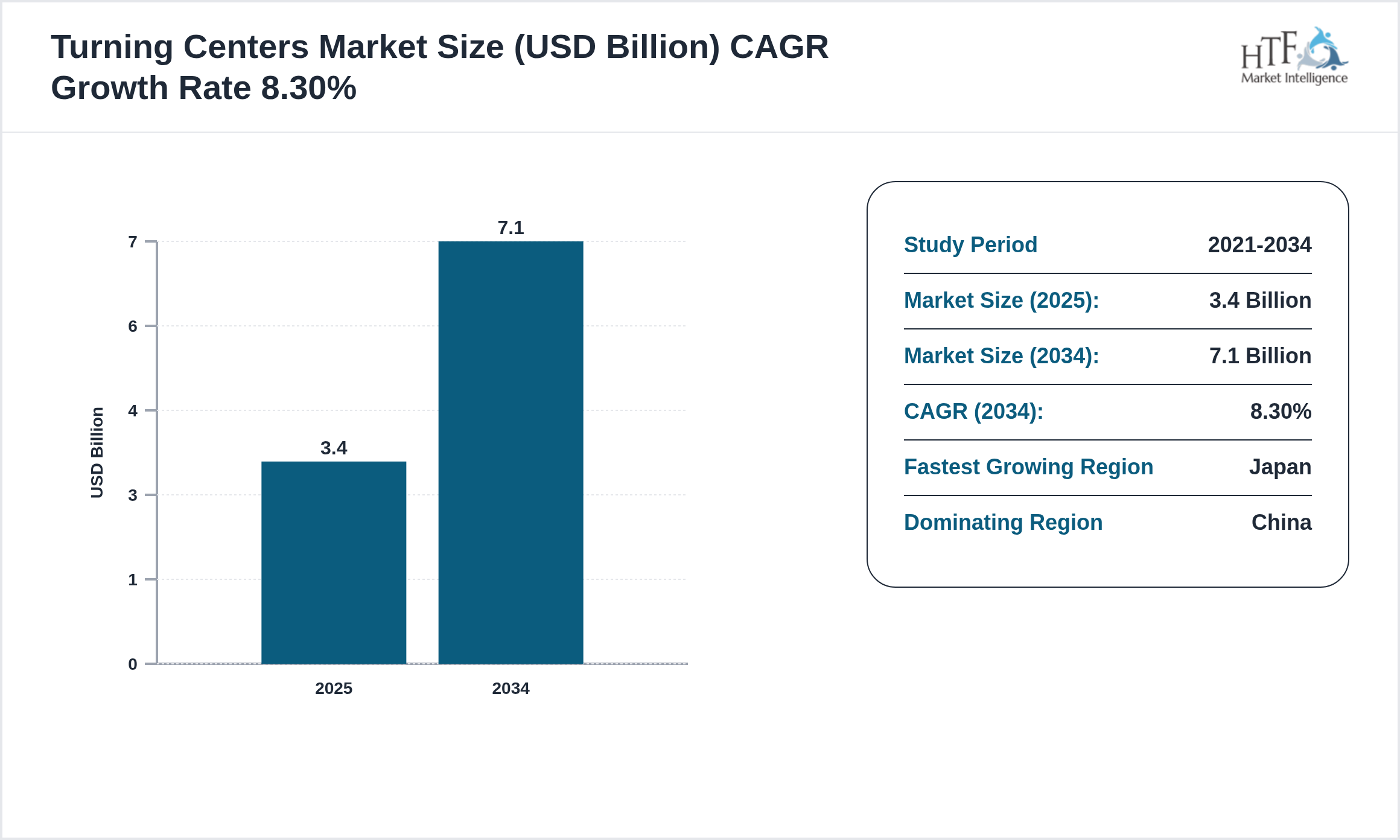
The Turning Centers market was valued at 3.4 billion in 2025 and is expected to reach usd 7.1 billion by 2021, growing at a compound annual growth rate (CAGR) of 8.30% over the forecast period.
The APAC Turning Centers Market comprises computer-controlled lathes and machining centers used for high-precision metal and plastic component manufacturing. It includes CNC lathes, multi-axis turning machines, automation integration, and maintenance services while excluding manual lathe operations. Market growth is driven by manufacturing modernization, automotive and aerospace sector expansion, and Industry 4.0 adoption. Demand-side drivers include precision machining, cycle time reduction, and production scalability. Supply-side transformation involves AI-assisted process optimization, IoT-enabled predictive maintenance, and robotics integration. Technological evolution encompasses multi-axis CNC control, adaptive machining, and real-time quality monitoring
Source: HTF Market Intelligence (HTF MI)
A Turning Centers market research study provides invaluable data-driven insights that allow businesses to make informed decisions based on accurate market trends, customer behaviors, and competitor analysis. These reports help organizations better understand the evolving needs of their target audience, enabling more customer-focused strategies.
Market Dynamics
Influencing Trend:
- • The market is witnessing trends such as multi-axis CNC turning centers hybrid machining systems IoT-enabled monitoring and predictive maintenance. Energy-efficient high-speed and high-precision equipment with integrated automation is increasingly adopted. Use of AI-driven process optimization and digital twin simulations is emerging. Vendors are offering modular designs and flexible tooling systems to meet diverse production requirements
- • The APAC Turning Centers market is expanding due to growing automotive aerospace electronics and precision engineering industries. Increased industrialization and demand for high-precision machining solutions are driving adoption. Investments in smart manufacturing CNC technology and automation for productivity improvement are boosting market growth. Rising focus on reducing lead times operational costs and material waste further encourages adoption of advanced turning centers
- • Challenges include high capital costs skilled labor shortages complex maintenance requirements and integration difficulties with legacy equipment. Operational challenges such as vibration control heat management and precision accuracy can affect productivity. Intense competition among global and regional vendors impacts pricing and margins. Supply chain disruptions for critical machine components and technology obsolescence risks are key barriers
- • Opportunities exist in automotive component manufacturing aerospace part production electronics and semiconductor machining and precision engineering applications. Small and medium-sized manufacturers are adopting subscription or lease-based equipment models. Growth in industrial automation smart factories and additive manufacturing integration provides additional commercial potential. Expansion of training and technical support services enhances adoption
The China Dominant Region currently dominates the market share, fueled by increasing consumption, population growth, and sustained economic progress, which collectively enhance market demand. Conversely, the {FASTEST GROWING REGION} is rapidly becoming the fastest-growing region, driven by significant infrastructure investments, industrial expansion, and rising consumer demand.
- Japan
- China
- Southeast Asia
- India
- Australia
- South Korea
- Others
Competitive Insights
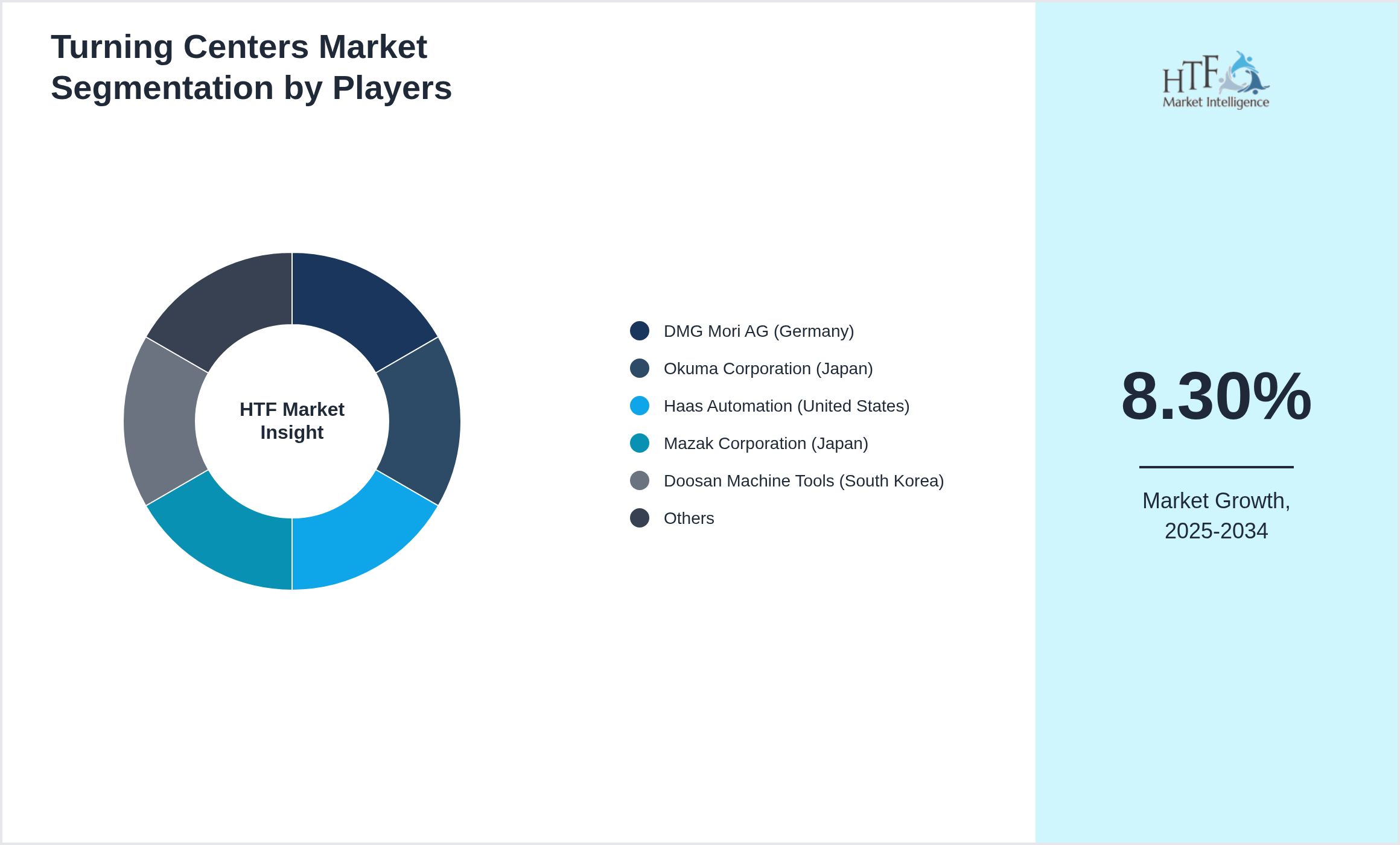
The key players in the Turning Centers are intensifying their focus on research and development (R&D) activities to innovate and stay competitive. Major companies, such as DMG Mori AG (Germany), Okuma Corporation (Japan), Haas Automation (United States), Mazak Corporation (Japan), Doosan Machine Tools (South Korea), Hurco Companies (United States), FANUC Corporation (Japan), Mitsubishi Heavy Industries (Japan), Hyundai WIA Corporation (South Korea), Index Traub (Germany), Emco Group (Austria), Chiron Group (Germany), Gildemeister (Germany), FPT Industrie (Italy), Spinner Werkzeugmaschinenfabrik GmbH (Germany), are heavily investing in R&D to develop new products and improve existing ones. This strategic emphasis on innovation drives significant advancements in product formulation and the introduction of sustainable and eco-friendly products.
Moreover, these established industry leaders are actively pursuing acquisitions of smaller companies to expand their regional presence and enhance their market share. These acquisitions not only help in diversifying their product portfolios but also provide access to new technologies and markets. This consolidation trend is a critical factor in the growth of the consumer goods industry, as it enables larger companies to streamline operations, reduce costs, and increase their competitive edge.
The companies highlighted in this profile were selected based on insights from primary experts and an evaluation of their market penetration, product offerings, and geographical reach:
- • DMG Mori AG (Germany)
- • Okuma Corporation (Japan)
- • Haas Automation (United States)
- • Mazak Corporation (Japan)
- • Doosan Machine Tools (South Korea)
- • Hurco Companies (United States)
- • FANUC Corporation (Japan)
- • Mitsubishi Heavy Industries (Japan)
- • Hyundai WIA Corporation (South Korea)
- • Index Traub (Germany)
- • Emco Group (Austria)
- • Chiron Group (Germany)
- • Gildemeister (Germany)
- • FPT Industrie (Italy)
- • Spinner Werkzeugmaschinenfabrik GmbH (Germany)
Key Highlights
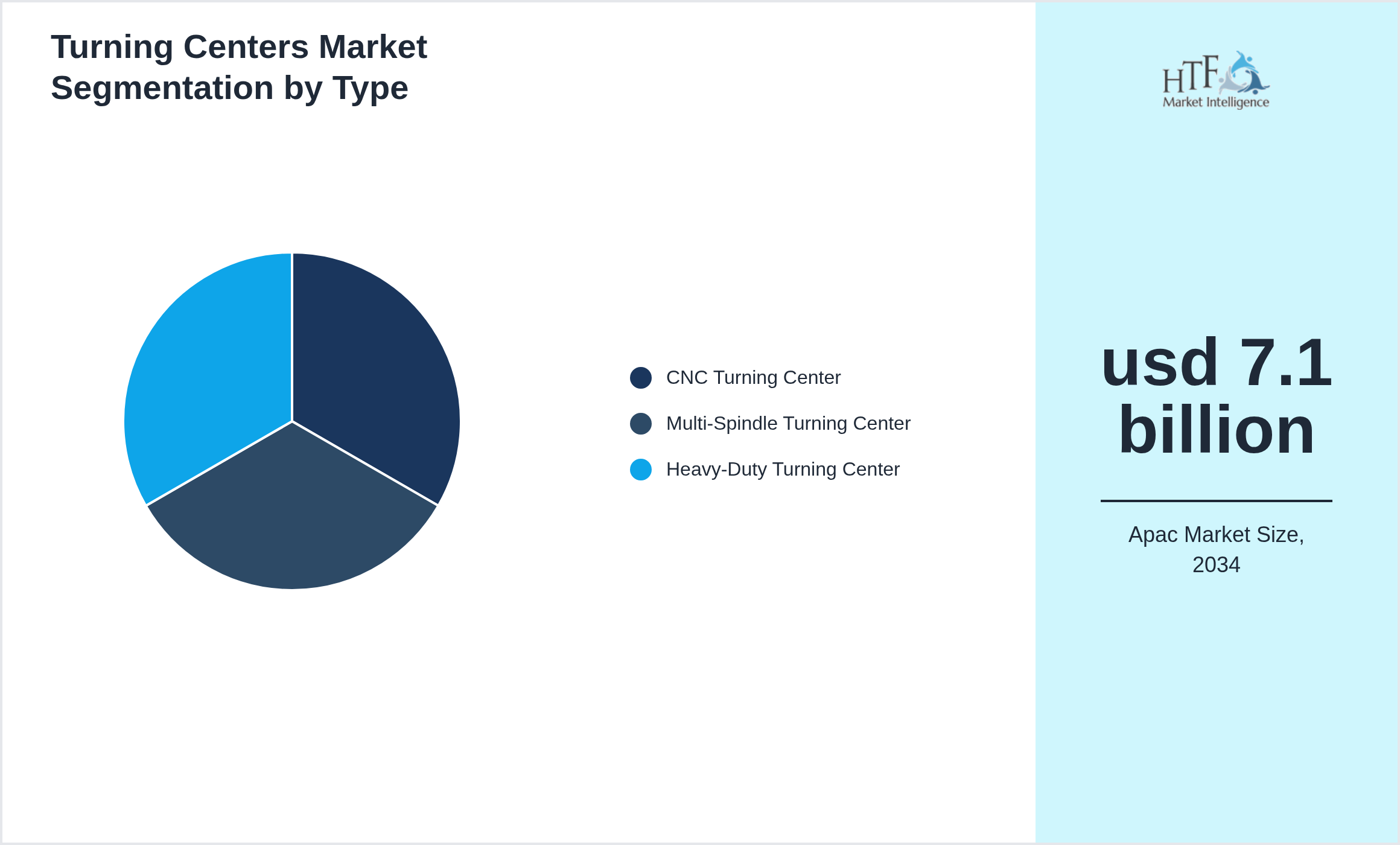
Segmentation by Type
- • CNC Turning Center
- • Multi-Spindle Turning Center
- • Heavy-Duty Turning Center
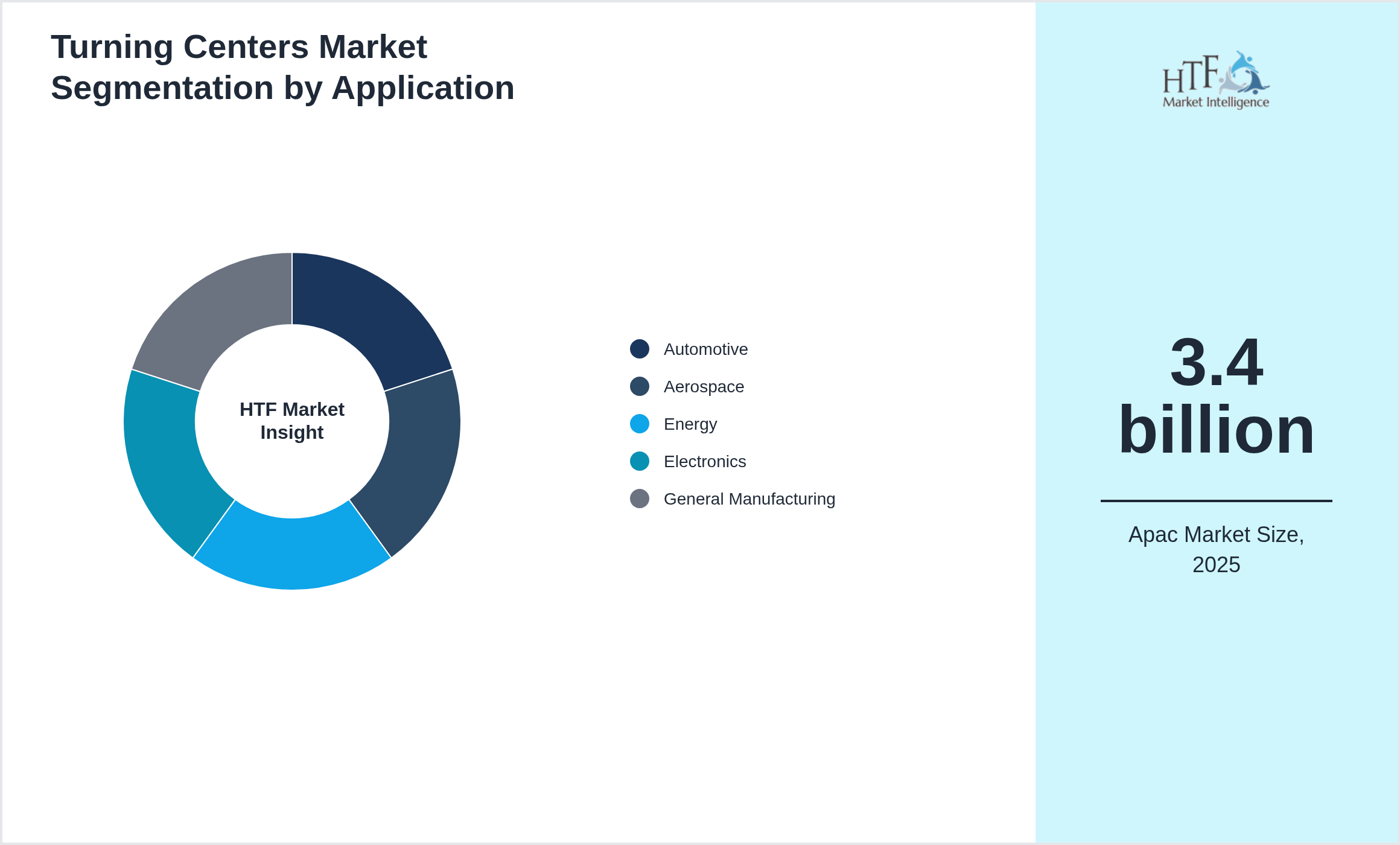
Segmentation by Application
- • Automotive
- • Aerospace
- • Energy
- • Electronics
- • General Manufacturing
Market Entropy
- • Q4 2025: Integration of AI-assisted CNC turning centers improved precision and reduced machining cycle times by 30%. Investment in flexible manufacturing cells expanded commercial scalability
- • Q3 2025: Digital transformation initiatives incorporated IoT-enabled tool condition monitoring. Sustainability milestones included low-energy spindles and optimized coolant systems
- • Q2 2025: Industry-wide operational shifts toward automated batch scheduling improved throughput and reduced labor dependency
- • Q1 2025: Production modernization integrated multi-axis turning capabilities and modular tooling systems for rapid changeovers
Merger & Acquisition
- • Feb 2024: DMG Mori acquired TurnTech Systems to expand CNC turning centers in APAC.
- • Aug 2024: Makino partnered with PrecisionMachine Labs to integrate advanced automation solutions.
- • Mar 2025: Okuma merged with SmartTurning Solutions to strengthen regional industrial machine tool portfolios.
Regulatory Landscape
- • The Asia-Pacific Turning Centers market is influenced by industrial machinery safety regulations ISO certification requirements and energy efficiency mandates. Local environmental regulations for industrial emissions and workplace safety influence plant operations. Import/export duties on high-precision machinery components affect cost structures. Regulatory emphasis on sustainable manufacturing encourages investment in energy-efficient and automated turning centers supporting production scalability and long-term profitability
Patent Analysis
- • APAC Turning Centers market participants are filing patents related to CNC machining accuracy multi-axis automation predictive maintenance and integrated IoT manufacturing analytics. Trademarks are registered for turning center brands smart machining platforms and digital factory solutions. Copyright activity includes CNC software process simulation tools and operator interface designs ensuring protection of proprietary manufacturing technologies
Investment and Funding Scenario
- • APAC Turning Centers are attracting funding for CNC modernization robotics integration and smart manufacturing deployment. Venture investments and strategic acquisitions support precision engineering AI-driven machining analytics and regional industrial expansion
Competitive Innovation Radar
- • The Apac Turning Centers market is transforming with AI-enabled CNC automation predictive analytics and smart monitoring systems. Competition among machine tool manufacturers is focused on precision manufacturing operational optimization technologies and digital traceability systems capable of improving machining efficiency by nearly 30%. IoT-integrated tool monitoring automated quality inspection and predictive maintenance platforms are enhancing production scalability and resource utilization. Sustainable productive technologies including low-energy motor drives smart coolant systems and automated workflow optimization are further improving operational efficiency and reducing environmental impact. Innovation cycles emphasize enhanced digital control systems and AI-driven machining analytics to accelerate performance improvements
The Top-Down and Bottom-Up Approaches
The top-down approach begins with a broad theory or hypothesis and breaks it down into specific components for testing. This structured, deductive process involves developing a theory, creating hypotheses, collecting and analyzing data, and drawing conclusions. It is particularly useful when there is substantial theoretical knowledge, but it can be rigid and may overlook new phenomena.
Conversely, the bottom-up approach starts with specific data or observations, from which broader generalizations and theories are developed. This inductive process involves collecting detailed data, analyzing it for patterns, developing hypotheses, formulating theories, and validating them with additional data. While this approach is flexible and encourages the discovery of new phenomena, it can be time-consuming and less structured.
Swot and Pestel Analysis
SWOT Analysis
A SWOT analysis evaluates a company’s internal strengths and weaknesses, as well as external opportunities and threats. This Turning Centers analysis helps businesses identify their competitive advantages, address internal challenges, and seize external opportunities while mitigating potential risks. It is performed to gain a comprehensive understanding of the organization's position in the market, align strategies with its strengths, and effectively navigate competitive landscapes.
PESTEL Analysis
Political, economic, social, technological, environmental, and legal factors impacting the business environment. This analysis helps organizations anticipate external changes, adapt strategies to macroeconomic trends, and ensure compliance with regulatory requirements. It is crucial for understanding the external forces that could influence business operations and for planning long-term strategies that align with evolving market conditions.
Report Infographics:
| Report Features | Details |
| Base Year | 2025 |
| Based Year Market Size 2025 | 3.4 billion |
| Historical Period | 2021 |
| CAGR (2025 to 2034) | 8.30% |
| Forecast Period | 2034 |
| Forecasted Period Market Size (2034) | usd 7.1 billion |
| Scope of the Report | By Type, By Application, By Sales Channel, By Region |
| Quantitative Units |
Revenue in USD million/billion, volume in kilotons, and CAGR from 2025 to 2034 |
| Companies Covered | DMG Mori AG (Germany), Okuma Corporation (Japan), Haas Automation (United States), Mazak Corporation (Japan), Doosan Machine Tools (South Korea), Hurco Companies (United States), FANUC Corporation (Japan), Mitsubishi Heavy Industries (Japan), Hyundai WIA Corporation (South Korea), Index Traub (Germany), Emco Group (Austria), Chiron Group (Germany), Gildemeister (Germany), FPT Industrie (Italy), Spinner Werkzeugmaschinenfabrik GmbH (Germany) |
| Customization Scope | 15% Free Customization (For example)
Want to Buy Specific Sections of This Report?
|
| Delivery Format | PDF and Excel through Email |