
Chemical synthesis Methyl Salicylate Market - Global Industry Size & Growth Analysis 2021-2034
Global Chemical synthesis Methyl Salicylate Market is segmented by Application (Pharmaceuticals, Food Flavoring, Cosmetics, Aromatherapy, Industrial Chemicals), Type (Natural Ester, Methyl Ester, Synthetic Salicylate, Industrial Grade, Lab Grade), and Geography (North America, LATAM, West Europe, Central & Eastern Europe, Northern Europe, Southern Europe, East Asia, Southeast Asia, South Asia, Central Asia, Oceania, MEA)
Pricing
Report Overview
Industry Overview
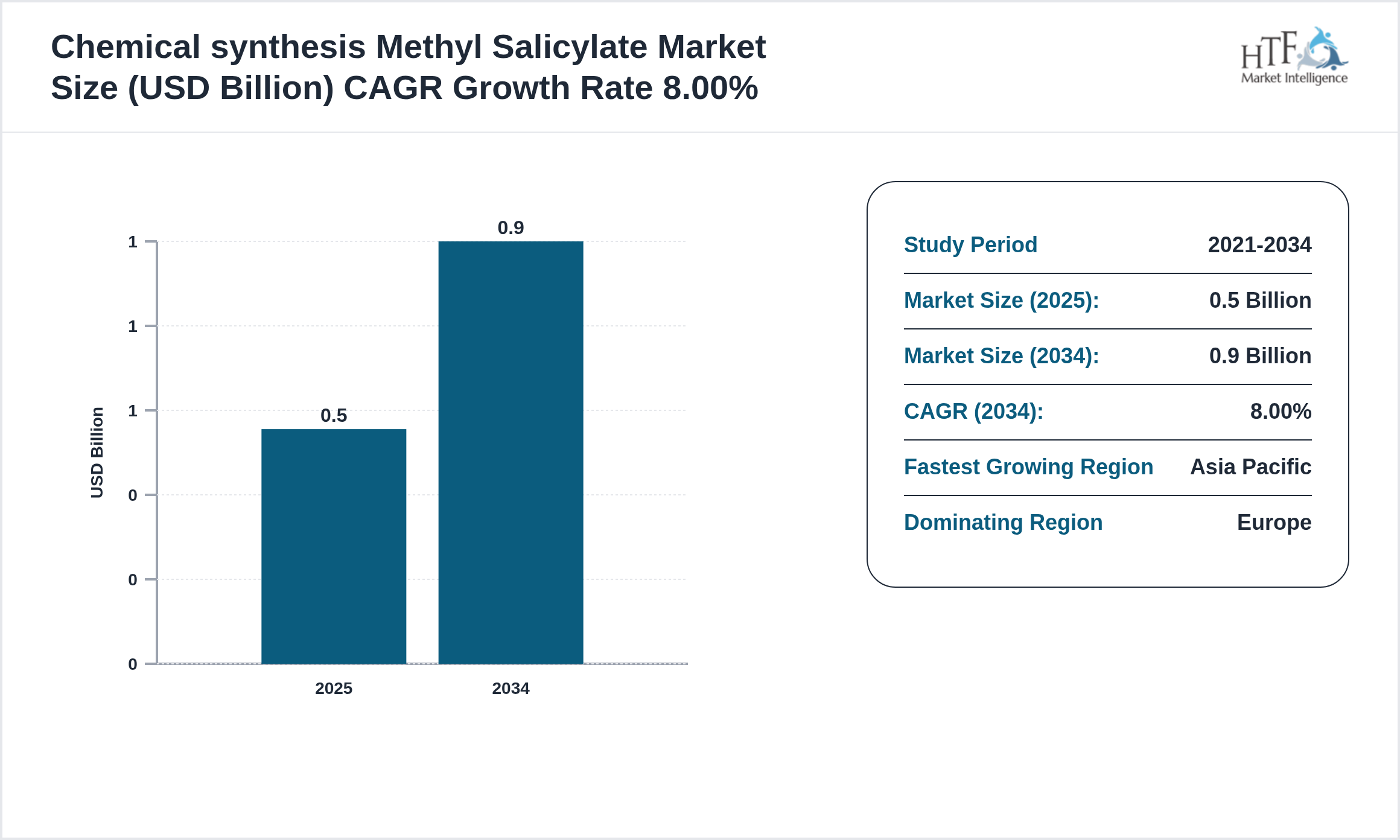
The Chemical synthesis Methyl Salicylate is at USD 0.5 billion in 2025 and is expected to reach 0.9 billion by 2034. The Chemical synthesis Methyl Salicylate is driven by increasing demand in end-use industries, technological advancements, research and development (R&D), economic growth, and global trade.
The Chemical Synthesis Methyl Salicylate Market includes the production, purification, and distribution of methyl salicylate used in pharmaceuticals, flavorings, and cosmetic applications. It covers raw materials, chemical reactors, catalysts, and quality control services while excluding natural extraction routes or unrelated chemical derivatives. Growth is driven by pharmaceutical demand, topical analgesic applications, and fragrance industry expansion. Demand-side dynamics include purity requirements, regulatory compliance, and seasonal consumption trends. Supply-side transformation features continuous flow synthesis, process optimization, and scale-up production. Technological evolution involves green chemistry methods, catalyst efficiency improvements, and automated process monitoring
Source: HTF Market Intelligence (HTF MI)
Competitive landscape
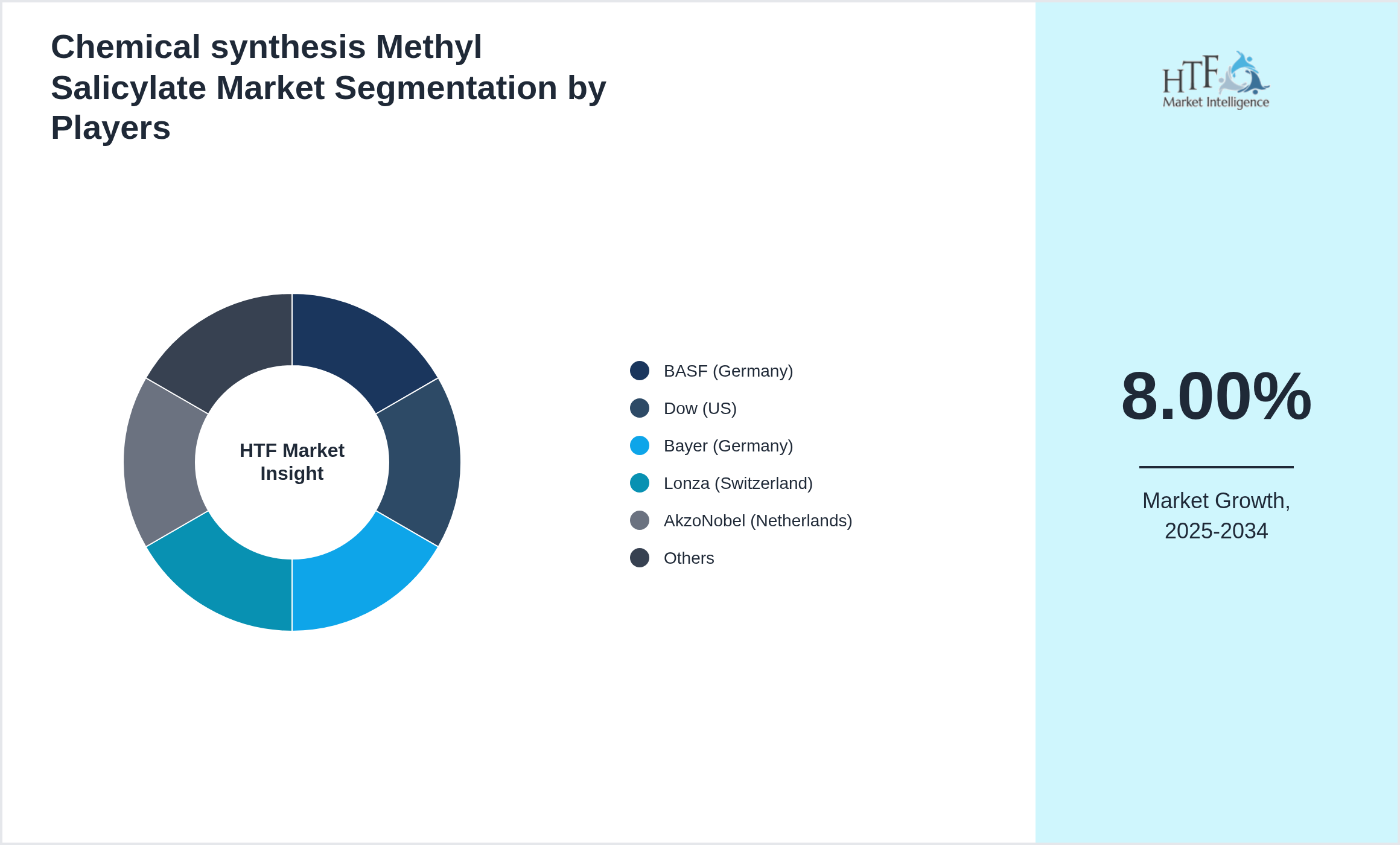
The companies highlighted in this profile were selected based on insights from primary experts and an evaluation of their market penetration, product offerings, and geographical reach:
- • BASF (Germany)
- • Dow (US)
- • Bayer (Germany)
- • Lonza (Switzerland)
- • AkzoNobel (Netherlands)
- • SABIC (Saudi Arabia)
- • Wacker Chemie (Germany)
- • Huntsman (US)
- • Lanxess (Germany)
- • Arkema (France)
- • Clariant (Switzerland)
- • Cipla (India)
- • DSM (Netherlands)
- • Mitsubishi Chemical (Japan)
- • Jubilant Life Sciences (India)
- • Anhui Meilan (China)
- • Anhui Jinhe (China)
- • Sinopec (China)
- • Evonik (Germany)
- • Gujarat Alkalies (India)
Market Drivers:
Challenge Factor:
Opportunities:
Important Trend:
Regulatory Framework
- • The production and distribution of methyl salicylate is controlled under chemical manufacturing regulations including REACH (EU) TSCA (US) and hazardous substance handling standards. Environmental compliance emissions monitoring and waste management are critical influencing operational expenditure. Certifications for industrial chemical use and safety labeling affect market access globally. Regulatory adherence reduces risk and supports consistent profitability while resource dependency on raw salicylic acid and supply-chain constraints influence production scalability
Regional Insight
The Europe leads the market share, largely due to rising consumption, a growing population, and strong economic momentum that boosts demand. In contrast, the Asia Pacific is emerging as the fastest-growing area, driven by rapid infrastructure development, the expansion of industrial sectors, and heightened consumer demand, making it a critical factor for future market growth. The regions covered in the report are
- North America
- LATAM
- West Europe
- Central & Eastern Europe
- Northern Europe
- Southern Europe
- East Asia
- Southeast Asia
- South Asia
- Central Asia
- Oceania
- MEA
Regional Analysis
- • The global Chemical Synthesis Methyl Salicylate market is anchored by chemical manufacturing clusters in China India and Europe due to strong production capabilities integrated supply chains and established export networks. Consumption is widespread across pharmaceuticals personal care and industrial applications. Regulatory frameworks ensure quality and safety compliance in key regions while R&D investment supports synthetic process optimization and greener synthesis routes. Industrial ecosystems leverage chemical intermediates raw material sourcing and contract manufacturing to strengthen market growth trajectory and create scalable commercial opportunities across global markets
Market Segmentation
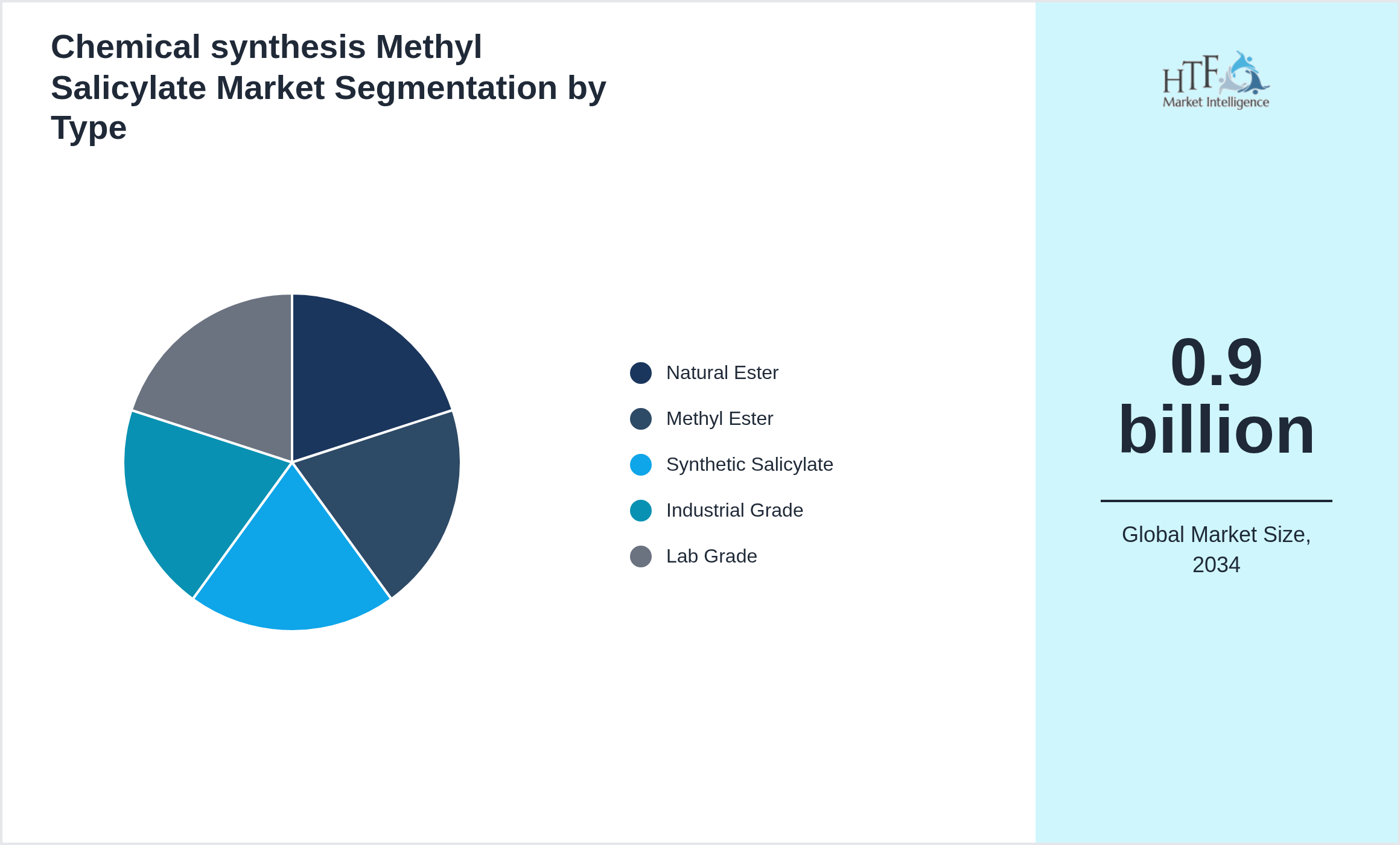
Segmentation by Type
- • Natural Ester
- • Methyl Ester
- • Synthetic Salicylate
- • Industrial Grade
- • Lab Grade
Segmentation by Application
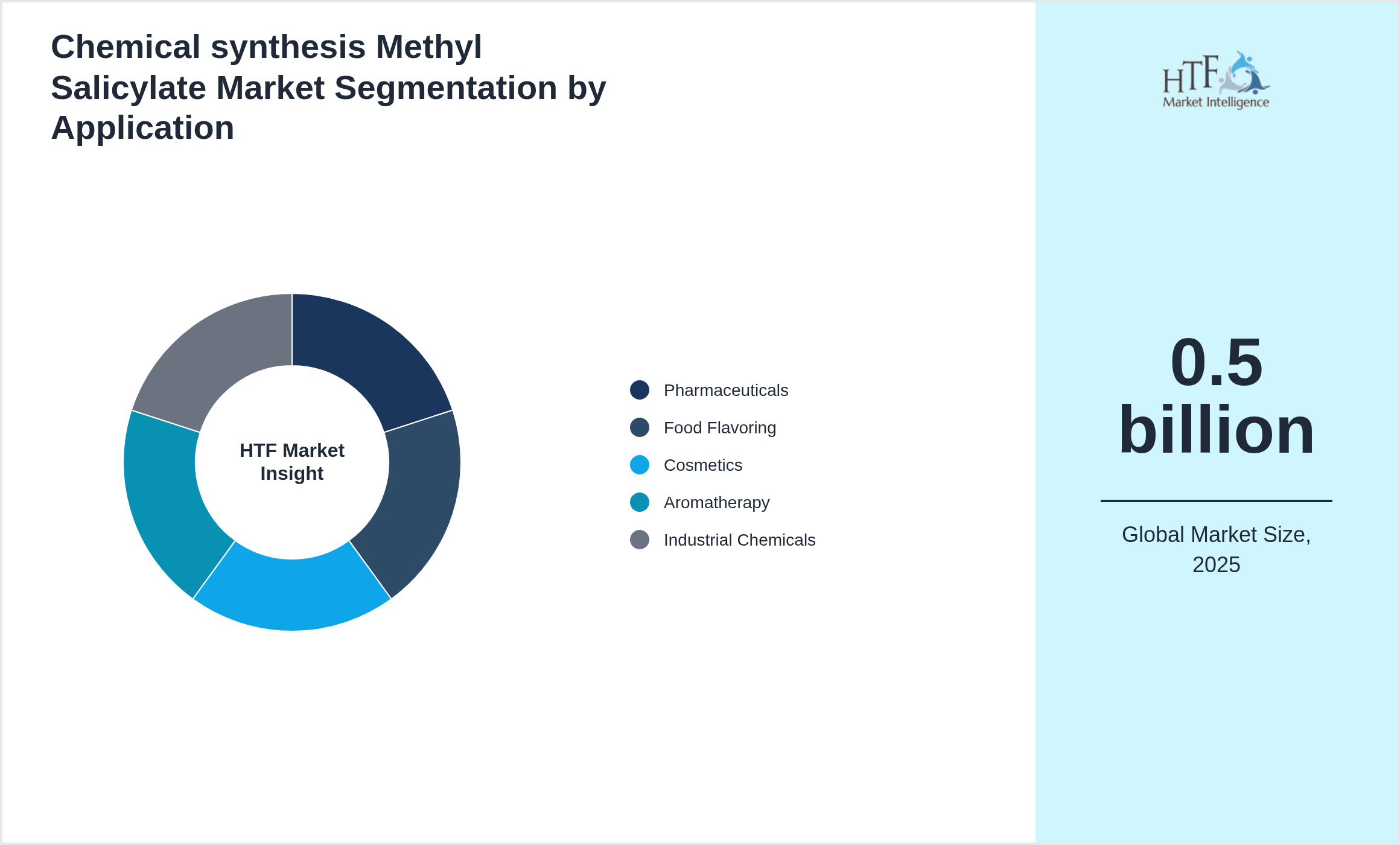
- • Pharmaceuticals
- • Food Flavoring
- • Cosmetics
- • Aromatherapy
- • Industrial Chemicals
Key Development Activities
Market Entropy
- • Q4 2025: Industrial chemical manufacturers implemented continuous flow synthesis increasing yield by 27% and reducing production cycle time. Investment in green chemistry approaches improved operational sustainability
- • Q3 2025: Industry-wide operational shifts toward automated process control enhanced product consistency and reduced batch rejection rates. Regulatory implementations on solvent recovery reduced environmental emissions
- • Q2 2025: Supply-chain transformation improved raw material sourcing efficiency and minimized lead times. Digital transformation initiatives enabled real-time monitoring of reaction parameters increasing commercial scalability
- • Q1 2025: Production modernization integrated modular reactor systems reducing manual handling and improving safety compliance across large-scale chemical plants
Merger & Acquisition
- • In 2024 increasing pharmaceutical and fragrance manufacturing supported demand for methyl salicylate synthesis
- • In 2025 innovation in bio-based and high-purity production accelerated market growth
- • By 2026 the market is expected to expand steadily with rising specialty chemical demand.
Regulatory Landscape
- • The production and distribution of methyl salicylate is controlled under chemical manufacturing regulations including REACH (EU) TSCA (US) and hazardous substance handling standards. Environmental compliance emissions monitoring and waste management are critical influencing operational expenditure. Certifications for industrial chemical use and safety labeling affect market access globally. Regulatory adherence reduces risk and supports consistent profitability while resource dependency on raw salicylic acid and supply-chain constraints influence production scalability
Patent Analysis
- • Industry players patent process optimizations catalyst formulations and scalable production techniques for methyl salicylate. Trademarks cover brand names for fragrance and pharmaceutical-grade products. Copyright protections apply to synthesis process simulation software digital reaction monitoring systems and quality management platforms
Investment and Funding Scenario
- • Funding is concentrated on expanding chemical synthesis capabilities for methyl salicylate production supporting pharmaceutical cosmetic and fragrance industries. Seed funding and private equity investments are directed toward process optimization green chemistry adoption and scale-up of continuous flow reactors. Strategic collaborations with academic research institutions accelerate innovation in catalytic synthesis processes
Report Details
| Report Features | Details |
| Base Year | 2025 |
| Based Year Market Size (2025) | 0.5 billion |
| Historical Period | 2021 to 2025 |
| CAGR (2025 to 2034) | 8.00% |
| Forecast Period | 2026 to 2034 |
| Forecasted Period Market Size (2034) | 0.9 billion |
| Scope of the Report | Natural Ester, Methyl Ester, Synthetic Salicylate, Industrial Grade, Lab Grade, Pharmaceuticals, Food Flavoring, Cosmetics, Aromatherapy, Industrial Chemicals |
| Companies Covered | BASF (Germany), Dow (US), Bayer (Germany), Lonza (Switzerland), AkzoNobel (Netherlands), SABIC (Saudi Arabia), Wacker Chemie (Germany), Huntsman (US), Lanxess (Germany), Arkema (France), Clariant (Switzerland), Cipla (India), DSM (Netherlands), Mitsubishi Chemical (Japan), Jubilant Life Sciences (India), Anhui Meilan (China), Anhui Jinhe (China), Sinopec (China), Evonik (Germany), Gujarat Alkalies (India) |
| Customization Scope | 15% Free Customization |
| Delivery Format | PDF and Excel through Email |
Research Methodology
The research methodology involves several key steps to ensure comprehensive and accurate insights. First, the objectives of the research are clearly defined, focusing on aspects such as market size, growth trends, and competitive dynamics. Data collection is conducted through both primary and secondary methods. Primary research includes interviews with industry experts, surveys, and focus groups to gather firsthand information, while secondary research involves analyzing existing reports, government publications, and company filings.
The collected data is then subjected to rigorous analysis, with quantitative methods used to evaluate market size and trends and qualitative methods applied to understand industry dynamics and consumer behavior. Findings are compiled into a detailed report featuring key insights, data visualizations, and strategic recommendations. Validation is achieved through data verification and peer reviews to ensure accuracy.
Finally, the research concludes with actionable insights and recommendations, along with suggestions for future studies to address emerging trends and gaps. This methodology provides a structured approach to understanding the {keywords} and guiding strategic decisions.
Research enthusiast focused on transforming data uncovering into actionable insights through data-driven decision-making.