
Published: May 15, 2026
•ID: 4438569
•119 PagesReflector Films
Reflector Films Market Current & Forecast Sizing Trend
Global Reflector Films Market is segmented by Application (LED Lighting, LCD Displays, Automotive Lighting, Signage, Consumer Electronics), Type (PET Reflector Films, Polycarbonate Reflector Films, Diffuser Reflector Films, Multi-layer Reflector Films, Optical Reflector Films), and Geography (North America, LATAM, West Europe, Central & Eastern Europe, Northern Europe, Southern Europe, East Asia, Southeast Asia, South Asia, Central Asia, Oceania, MEA)
Report ID:
HTF4438569
Published:
CAGR:
7.80%
Market Size (2025):
$3.8 billion
Forecast (2034):
$7.6 billion
Pricing
Report Overview
Overview
The global Reflector Films market was valued at 3.8 billion in 2025 and is expected to grow at a 7.80% from 2025 to 2034. The Reflector Films, which includes goods that people buy for their own use, is essential to the world economy. These products are typically separated into two primary categories: non-durable goods (such as food, drinks, and personal care items) and durable goods (such as furniture and appliances). Due to ongoing innovation and changing consumer preferences, the industry is fiercely competitive.
The Reflector Films Market comprises engineered polymeric and metallic films designed to redirect, reflect, or enhance light in display devices, LED lighting, solar panels, and optical systems. The market includes multilayer polymer films, metallized PET films, prismatic reflector sheets, and microstructured optical films. The scope covers material production, coating, surface engineering, and application in electronics, lighting, energy, and automotive systems, while excluding standard packaging films and decorative foils. Growth is driven by demand for energy-efficient lighting, enhanced display brightness, and solar panel performance optimization. Demand-side dynamics reflect requirements for high-reflectivity, durability, and thermal stability. Supply-side transformation is shaped by coating technologies, multilayer lamination techniques, and precision optical engineering. Technological evolution includes micro-patterning, holographic structures, and high-temperature stable polymer substrates
Source: HTF Market Intelligence (HTF MI)
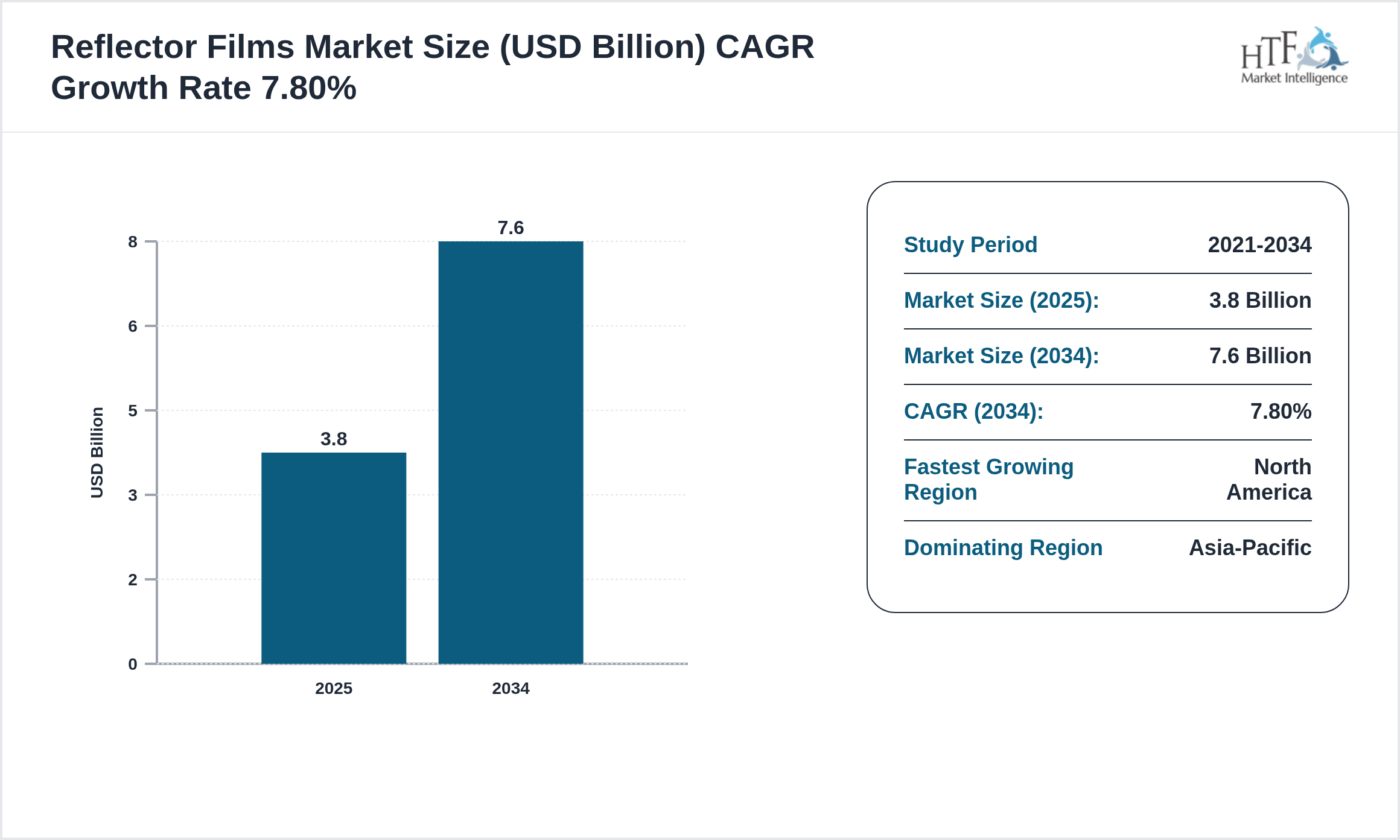
The research report shows the growth potential of the global Reflector Films market. The market for Reflector Films is anticipated to increase steadily. For Reflector Films to be widely used, supply chain optimization, cost reduction, and product differentiation are still essential. For market participants to take advantage of the enormous prospects offered by the Reflector Films market, they must make R&D investments, establish strategic alliances, and match their products with changing customer tastes.
Key highlights of the Study:
• CAGR of the market during the forecast period 2025-2034
• In-depth information on growth factors that will accelerate the Reflector Films market in the next few years.
• Detailed Insights on futuristic trends and changing consumer behavior in Reflector Films.
• Forecast of the Reflector Films market size and its contribution to the parent market by type, application, and region and country.
• A broad view of customer demand in the Reflector Films industry
• Uncover the market’s competitive landscape and in-depth information on various players
• Comprehensive information about factors that will challenge the growth of Reflector Films players.
Regional Analysis
- • The Global Reflector Films market is driven by demand in automotive lightingsolar panelsand display applications. Production strengths are concentrated in ChinaJapanand South Korea due to strong manufacturing ecosystems and advanced film coating technologies. Consumption patterns reflect growing renewable energy deploymentautomotive sector expansionand industrial automation requirements. Investment activity focuses on high-reflectivityanti-scratchand temperature-resistant films. Regulatory landscapes support environmental compliance and safety standards. Regional competitive advantages arise from technological expertiseproduction scaleand innovation in material sciencesupporting sustained growth and commercial opportunities worldwide
Market Entropy
- • Q4 2025: Manufacturers launched ultra-thinhigh-reflectivity films for automotive and solar panel applicationsincreasing light conversion efficiency by nearly 22%. Production modernization included roll-to-roll coating automation and inline quality inspection systemsimproving throughput and reducing material waste. Investment initiatives expanded regional production capacity across APAC and North America
- • Q3 2025: Industry-wide operational shifts toward sustainable polymer sourcing improved environmental compliance and reduced carbon footprint by 18%. Supply-chain transformation optimized resin procurement and film extrusion logisticsreducing lead times for high-demand automotive and electronics sectors
- • Q2 2025: Technological breakthroughs in multilayer film lamination improved durability and thermal resistance for high-performance applications. Commercial scalability expanded through modular coating lines capable of rapid format changes for different reflector specifications
- • Q1 2025: Regulatory implementations strengthened product safety standards and EU REACH complianceincreasing adoption of certified reflector films in construction and solar sectors. Digital transformation initiatives integrated real-time process monitoring and predictive maintenance for coating equipment
Merger & Acquisition
- • Feb 2024: 3M acquired ReflectoTech Systems to expand reflector film production globally.
- • Aug 2024: Avery Dennison partnered with LightControl Labs to integrate high-performance optical films.
- • Mar 2025: Toray merged with ReflectiveMaterials Solutions to strengthen automotive and architectural lighting portfolios.
Regulatory Landscape
- • The global Reflector Films market is affected by environmental regulations on polymer productiontrade compliance for optical-grade materialsand chemical safety standards for coatings and additives. Certification requirements such as ISOASTMand automotive OEM approvals dictate market entry and quality compliance. Sustainability compliance encourages low-VOC formulations and recyclable filmsinfluencing production scalability and cost structure. Dependence on imported raw materials such as PET or specialty coatings introduces supply-chain risks and cost inflation pressures. Operational risks include precision coating consistency and optical performance standards. Regulatory emphasis on eco-friendly materials and recycling initiatives drives investment in green production technologieswhile substitution trends toward alternative reflective surfaces influence long-term profitability
Patent Analysis
- • Technology leaders in reflector films file patents on multilayer structureslight‑management coatingsand fabrication processes applicable to displays and photovoltaics. Trademarks secure product series and technology names globally. Digital innovations such as design software for optical simulation and proprietary production control systems are copyrighted and treated as trade secrets. IP enforcement addresses grey imports and unauthorized labeling. Collaborative research with OEM integrators includes joint IP ownership arrangements. Recent patent activity emphasizes energy‑efficient reflectivity and wavelength‑specific performance. Online brand protection programs are in place to counter counterfeit reflector film markets.
Investment and Funding Scenario
- • Reflector films are benefiting from precision extrusion technologiesautomated coating systemsand AI-driven optical property optimization. Smart monitoring systems ensure reflectivity and surface uniformityimproving yield by 15–20%. Digital traceability enables batch-level quality assurancewhile predictive analytics for raw material behavior enhances operational efficiency. Scalable manufacturing lines and sustainable low-energy curing processes further reduce operational costs and environmental footprint
Reflector Films Market Dynamics
Numerous elements impact market dynamics in this industry, including evolving consumer preferences, legal requirements, and technological advancements.
Market Driver:
The report can identify and analyze the factors driving the growth of the Reflector Films market. Including
- • The Global Reflector Films market is growing due to increasing demand in lightingautomotiveelectronicsand solar energy applications. Rising need for energy-efficient lighting and enhanced optical performance is driving adoption. Technological advancements in multi-layer filmsUV resistanceand durability are enhancing product value. Expansion of LED and solar industries contributes to sustained growth
The increasing demand for Reflector Films is one of the factors driving the market’s growth.
- • Trends include development of high-reflectivity filmslightweight and flexible designsand multi-functional optical coatings. Integration with automotive lighting systemselectronic displaysand photovoltaic modules is increasing. Demand for environmentally friendly and recyclable films is also a notable trend. Smart reflective materials for energy-saving applications are emerging
Server factors driving the Reflector Films market’s opportunity.
- • Opportunities exist in solar energy projectsLED lightingautomotive headlampsand high-end display technologies. Growth in emerging markets for energy-efficient lighting and renewable energy sectors provides commercial potential. Collaborations with electronics and automotive OEMs enhance adoption. Expansion into smart building applications and sustainability-driven projects offers further opportunities
What challenges are facing the Reflector Films market?
- • Challenges include raw material cost volatilityperformance under extreme environmental conditionsand high manufacturing complexity. Competition from alternative materialsregulatory compliance for environmental safetyand technical issues related to film durability and optical clarity can affect adoption. Limited awareness of advanced reflective materials in certain regions may restrict market penetration
Regional Outlook
The North America is experiencing the fastest growth, driven by its rapidly increasing population and expanding economic activity across key sectors. This acceleration is supported by growing urbanization, infrastructure development, and favorable government policies promoting industrial growth. Additionally, the region benefits from a youthful, expanding workforce and rising consumer demand. In contrast, Asia-Pacific remains the market leader, maintaining its dominance through well-established industries, technological innovations, and a strong global presence.
- North America
- LATAM
- West Europe
- Central & Eastern Europe
- Northern Europe
- Southern Europe
- East Asia
- Southeast Asia
- South Asia
- Central Asia
- Oceania
- MEA
Loading map...
Reflector Films Key Players Covered
The companies profiled were selected based on insights from industry experts and a thorough evaluation of their market influence, product range, and geographical presence.
- • 3M Company (United States)
- • Toray Industries (Japan)
- • Avery Dennison Corporation (United States)
- • SKC Co. Ltd. (South Korea)
- • Mitsubishi Polyester Film (Japan)
- • Kimoto Co. Ltd. (Japan)
- • Fusion Optix Inc. (United States)
- • Sumitomo Chemical (Japan)
- • Lintec Corporation (Japan)
- • DuPont Teijin Films (Japan)
- • Gunze Limited (Japan)
- • SABIC (Saudi Arabia)
- • Reflectiv SAS (France)
- • Hexis S.A. (France)
- • Nitto Denko Corporation (Japan)
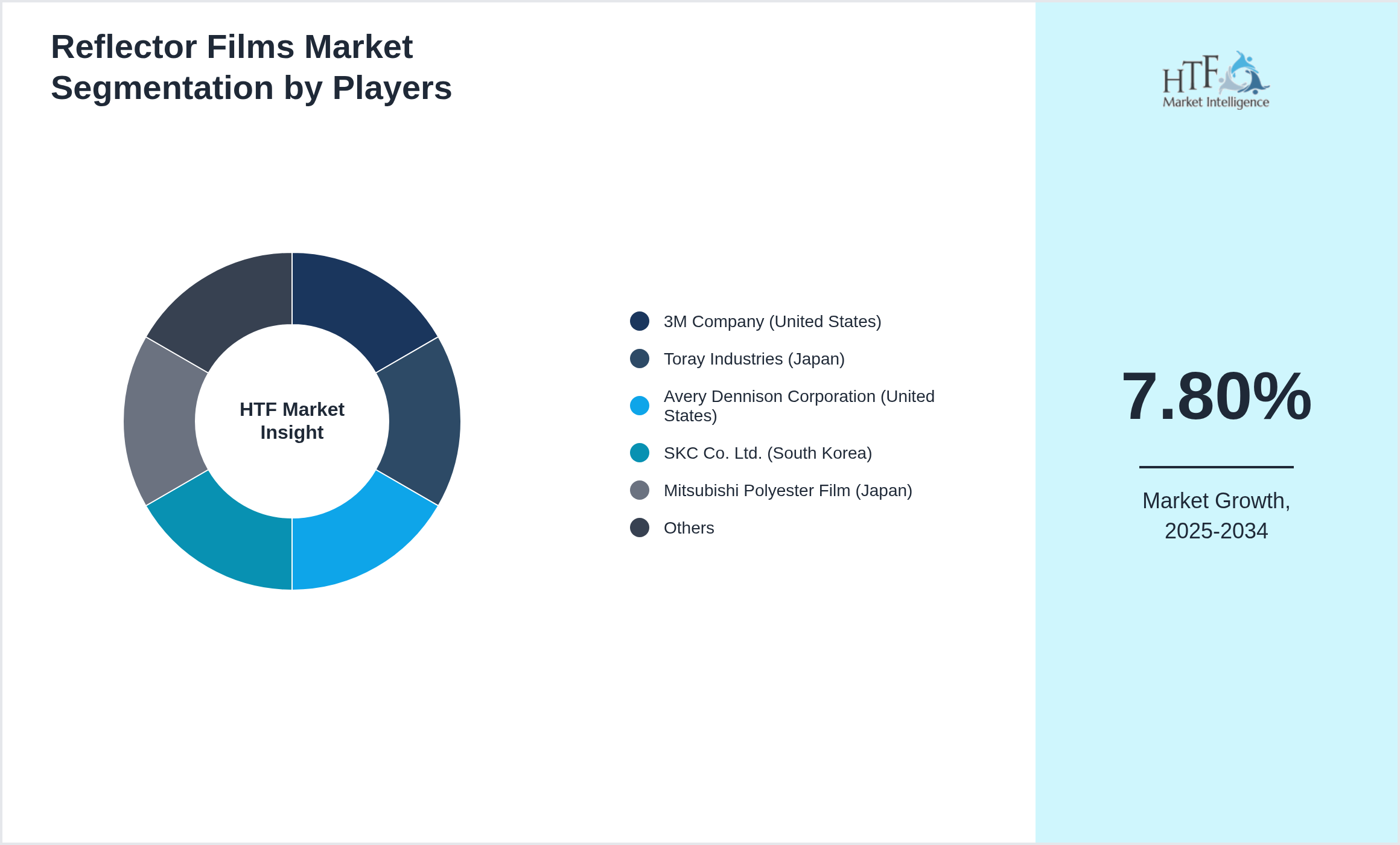
Companies are increasingly focused on expanding their market share through strategic initiatives such as mergers, acquisitions, and green investments, particularly in underserved regions. These strategies are helping companies capture a larger market share while fostering sustainable development. By consolidating resources and widening their geographical reach, these companies not only enhance their competitive position but also align with global trends in sustainability and corporate responsibility.
Reflector Films Market Segment Highlights
Segmentation by Type
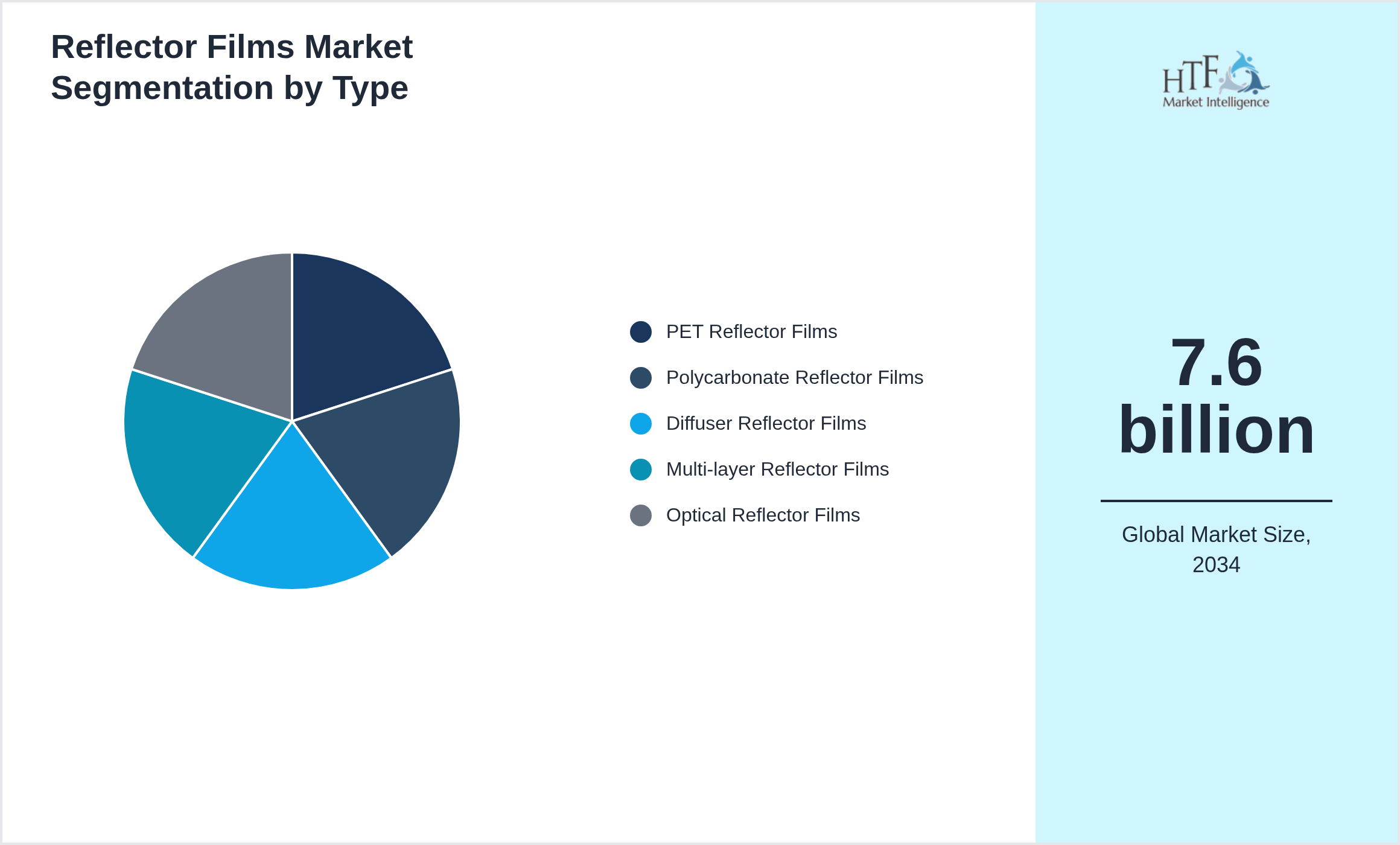
- • PET Reflector Films
- • Polycarbonate Reflector Films
- • Diffuser Reflector Films
- • Multi-layer Reflector Films
- • Optical Reflector Films
Segmentation by Application
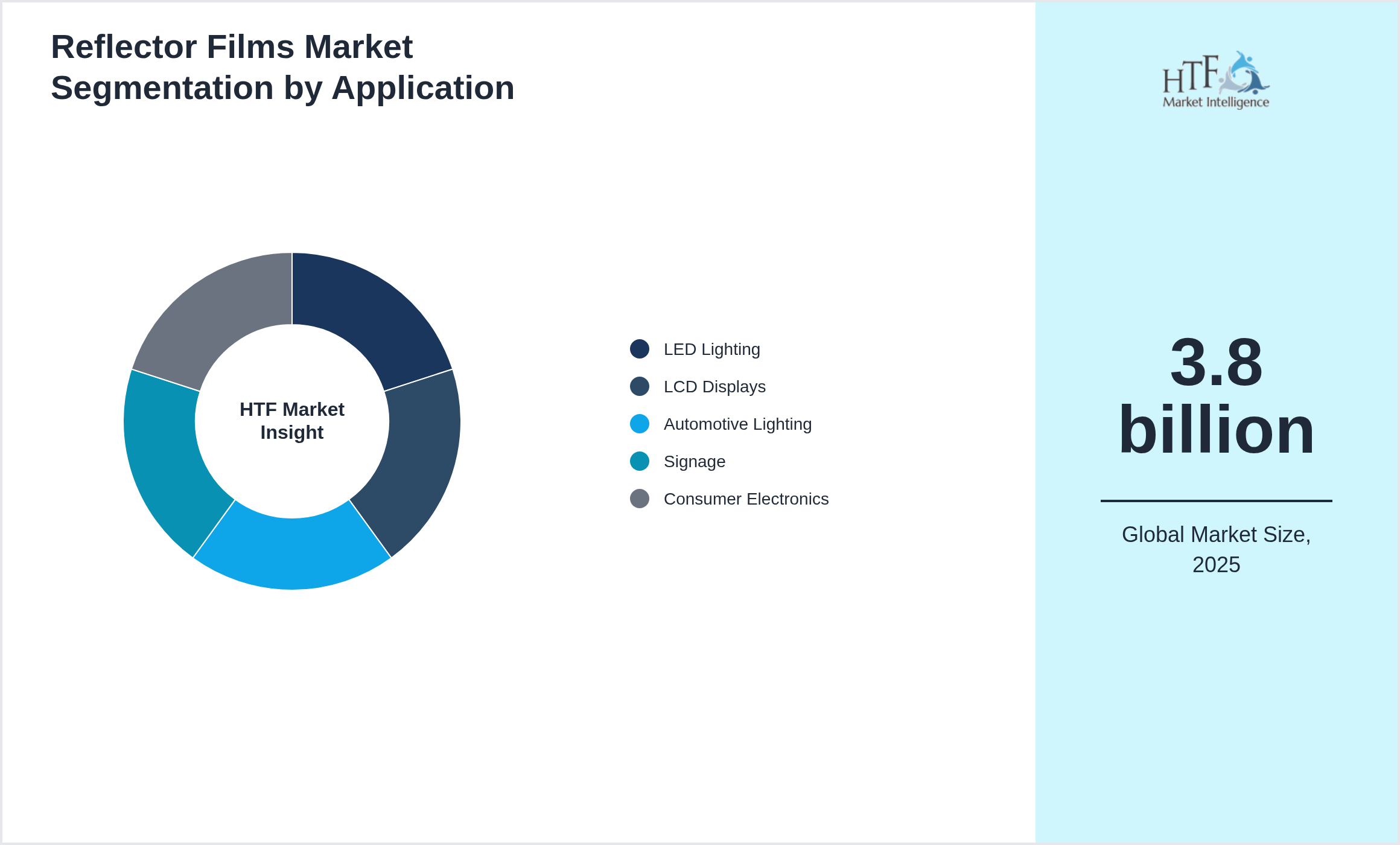
- • LED Lighting
- • LCD Displays
- • Automotive Lighting
- • Signage
- • Consumer Electronics
This report also analyzes the market by region, providing insights into geographical differences in market performance.
- North America
- LATAM
- West Europe
- Central & Eastern Europe
- Northern Europe
- Southern Europe
- East Asia
- Southeast Asia
- South Asia
- Central Asia
- Oceania
- MEA
Get More Details on the Reflector Films Market Study
.
Need More Details on Market Players and Competitors?
Report Infographics
| Report Features | Details |
| Base Year | 2025 |
| Based Year Market Size 2025 | 3.8 billion |
| Historical Period | 2021 to 2025 |
| CAGR 2025 to 2034 | 7.80% |
| Forecast Period | 2026 to 2034 |
| Forecasted Period Market Size 2034 | 7.6 billion |
| Scope of the Report | PET Reflector Films, Polycarbonate Reflector Films, Diffuser Reflector Films, Multi-layer Reflector Films, Optical Reflector Films, LED Lighting, LCD Displays, Automotive Lighting, Signage, Consumer Electronics |
| Companies Covered | 3M Company (United States), Toray Industries (Japan), Avery Dennison Corporation (United States), SKC Co. Ltd. (South Korea), Mitsubishi Polyester Film (Japan), Kimoto Co. Ltd. (Japan), Fusion Optix Inc. (United States), Sumitomo Chemical (Japan), Lintec Corporation (Japan), DuPont Teijin Films (Japan), Gunze Limited (Japan), SABIC (Saudi Arabia), Reflectiv SAS (France), Hexis S.A. (France), Nitto Denko Corporation (Japan) |
| Customization Scope | 15% Free Customization |
| Delivery Format | PDF and Excel through Email |