
AI Powered Road Condition Monitoring Market - Global Share, Size & Changing Dynamics 2021-2034
Global AI Powered Road Condition Monitoring Market is segmented by Application (Highways, Urban Roads, Traffic Management, Smart Cities, Infrastructure Planning), Type (IoT, AI, Edge, Cloud-Based, Sensor-Driven), and Geography (North America, LATAM, West Europe, Central & Eastern Europe, Northern Europe, Southern Europe, East Asia, Southeast Asia, South Asia, Central Asia, Oceania, MEA)
Pricing
Report Overview
Industry Overview
The AI Powered Road Condition Monitoring is at 0.36 billion in 2025 and is expected to reach 0.88 billion by 2034. The AI Powered Road Condition Monitoring is driven by factors such as increasing demand in end-use industries, technological advancements, research and development (R&D), economic growth, and increasing global trade. Siemens Mobility (Germany), Bosch (Germany), Huawei (China), Nokia (Finland), Ericsson (Sweden), IBM (USA), Intel (USA), Trimble (USA), Cisco (USA), Peloton Technology (USA), Mobileye (Israel), Sensys Networks (Sweden), Streetline (USA), Iteris (USA), Inrix (USA), Waycare (Israel), Kapsch TrafficCom (Austria), Swarco (Austria), TomTom (Netherlands), HERE Technologies (Netherlands) and others are some of the key players in the market.
AI Powered Road Condition Monitoring refers to systems that detect and assess pavement quality potholes cracks lane markings surface wear flooding snow debris and infrastructure deterioration using cameras sensors connected vehicles drones and AI image analytics. These platforms help transport agencies and road operators prioritize maintenance improve safety and reduce infrastructure repair costs. The market supports smart cities highway operators engineering firms municipal governments and infrastructure asset managers. It enables continuous road quality assessment predictive maintenance planning and better allocation of public infrastructure budgets.
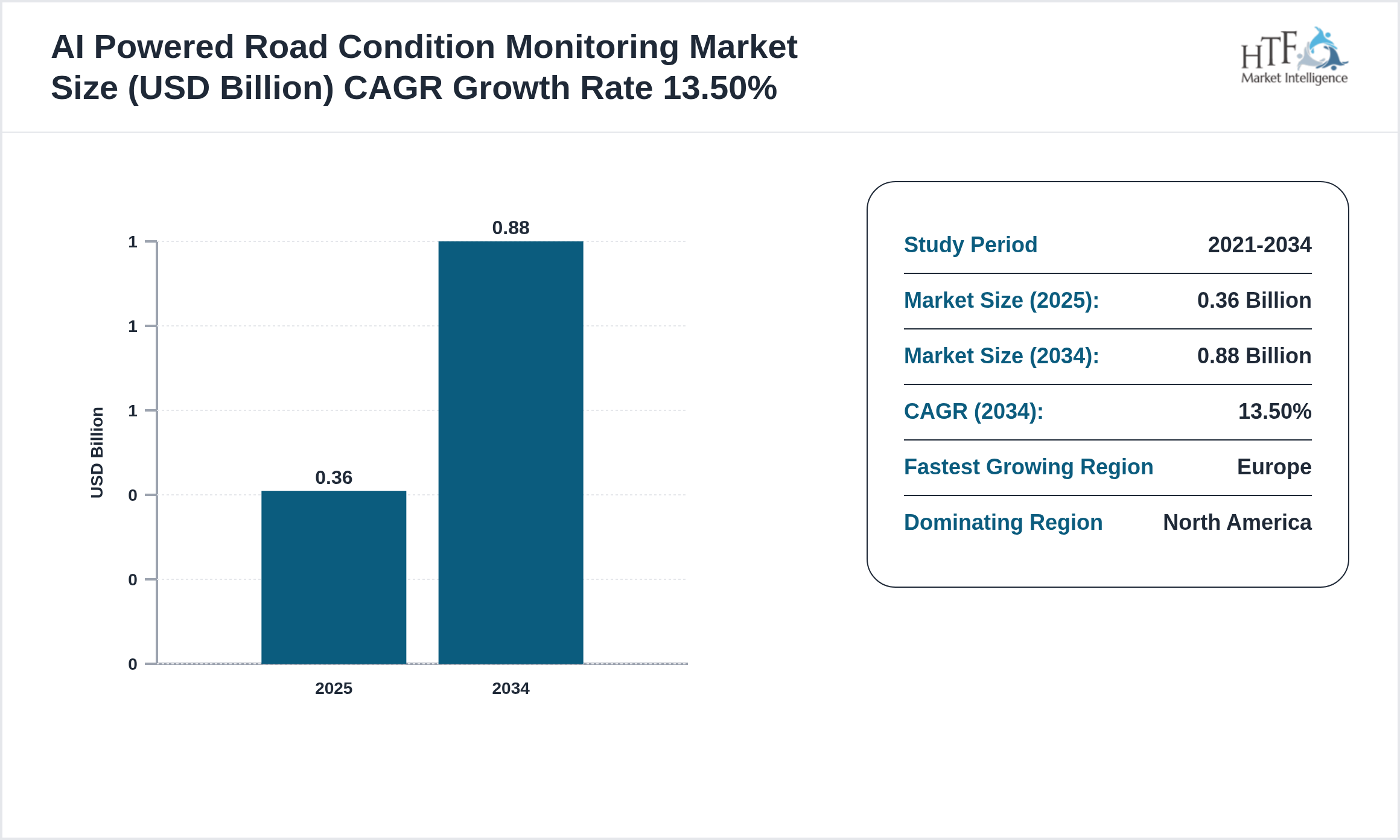
Source: HTF Market Intelligence (HTF MI)
Key Players
Several key players in the AI Powered Road Condition Monitoring market are strategically focusing on expanding their operations in developing regions to capture a larger market share, particularly as the year-on-year growth rate for the market stands at 12.20%. The companies featured in this profile were selected based on insights from primary experts, evaluating their market penetration, product offerings, and geographical reach.
- • Siemens Mobility (Germany)
- • Bosch (Germany)
- • Huawei (China)
- • Nokia (Finland)
- • Ericsson (Sweden)
- • IBM (USA)
- • Intel (USA)
- • Trimble (USA)
- • Cisco (USA)
- • Peloton Technology (USA)
- • Mobileye (Israel)
- • Sensys Networks (Sweden)
- • Streetline (USA)
- • Iteris (USA)
- • Inrix (USA)
- • Waycare (Israel)
- • Kapsch TrafficCom (Austria)
- • Swarco (Austria)
- • TomTom (Netherlands)
- • HERE Technologies (Netherlands)
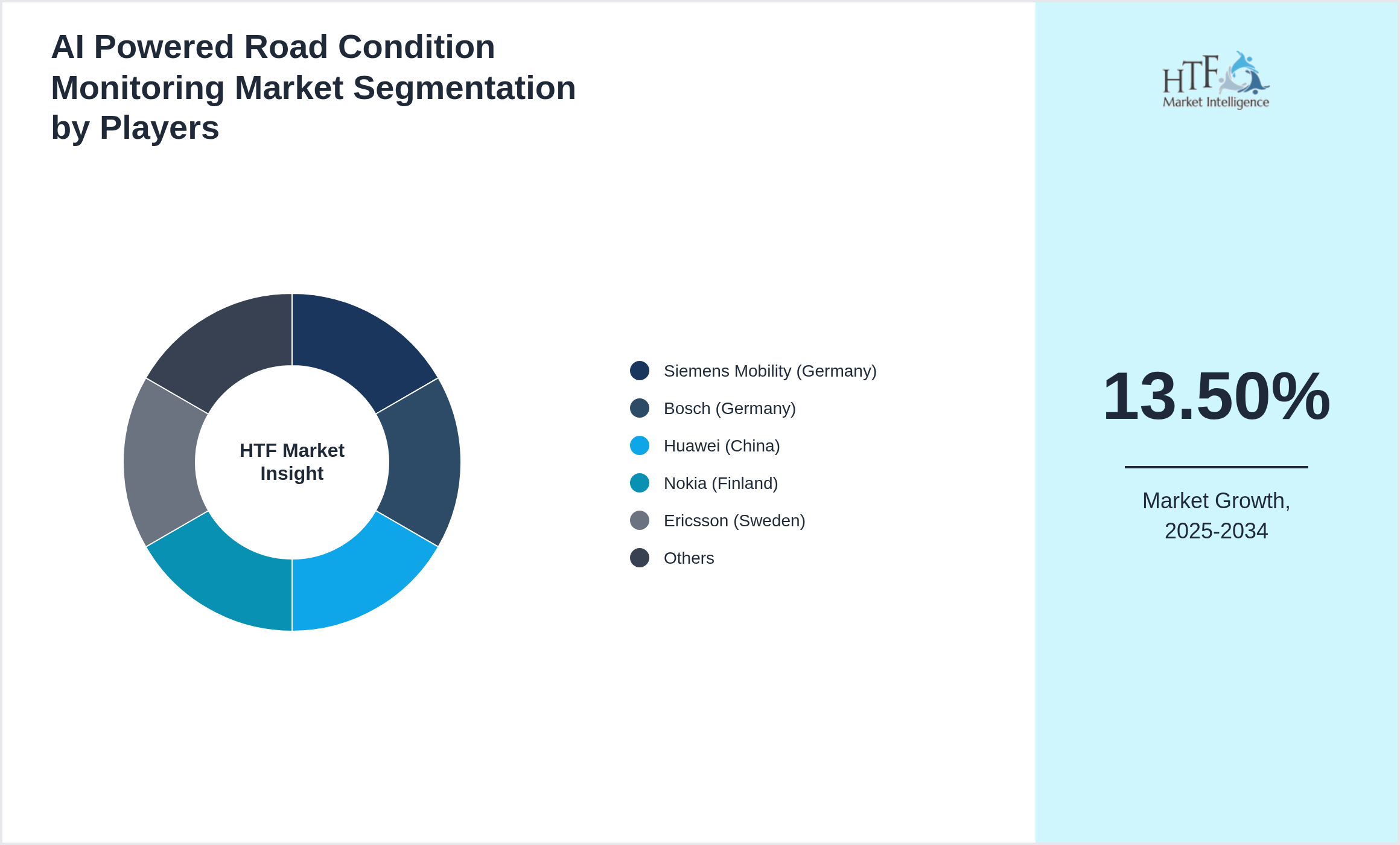
AI Powered Road Condition Monitoring Market Dynamics Highlights
Key Highlights
- The AI Powered Road Condition Monitoring is growing at a 13.50% during the forecasted period of 2021 to 2034
- Based on type, the market is bifurcated into IoT, AI, Edge, Cloud-Based, Sensor-Driven
- Based on application, the market is segmented into Highways, Urban Roads, Traffic Management, Smart Cities, Infrastructure Planning
- Global import/export in terms of K tons, K units, and metric tons will be provided if applicable based on industry best practices.
Market Segmentation Overview
- Type Segmentation: categorizes products by their specific variants, helping businesses identify demand drivers and innovate effectively.
- Application Segmentation: Divides the market based on product usage across industries, enabling targeted marketing and growth identification.
- Geographic Segmentation: Segments the market by location, allowing for tailored strategies based on regional preferences and economic factors.
- Customer Segmentation: Focuses on demographics like age, gender, and income, enabling personalized marketing and improved customer targeting.
- Distribution Channel Segmentation: categorizes how products reach customers, optimizing supply chain and sales strategies.
Market Segmentation
Segmentation by Type
- • IoT
- • AI
- • Edge
- • Cloud-Based
- • Sensor-Driven
Segmentation by Application
- • Highways
- • Urban Roads
- • Traffic Management
- • Smart Cities
- • Infrastructure Planning
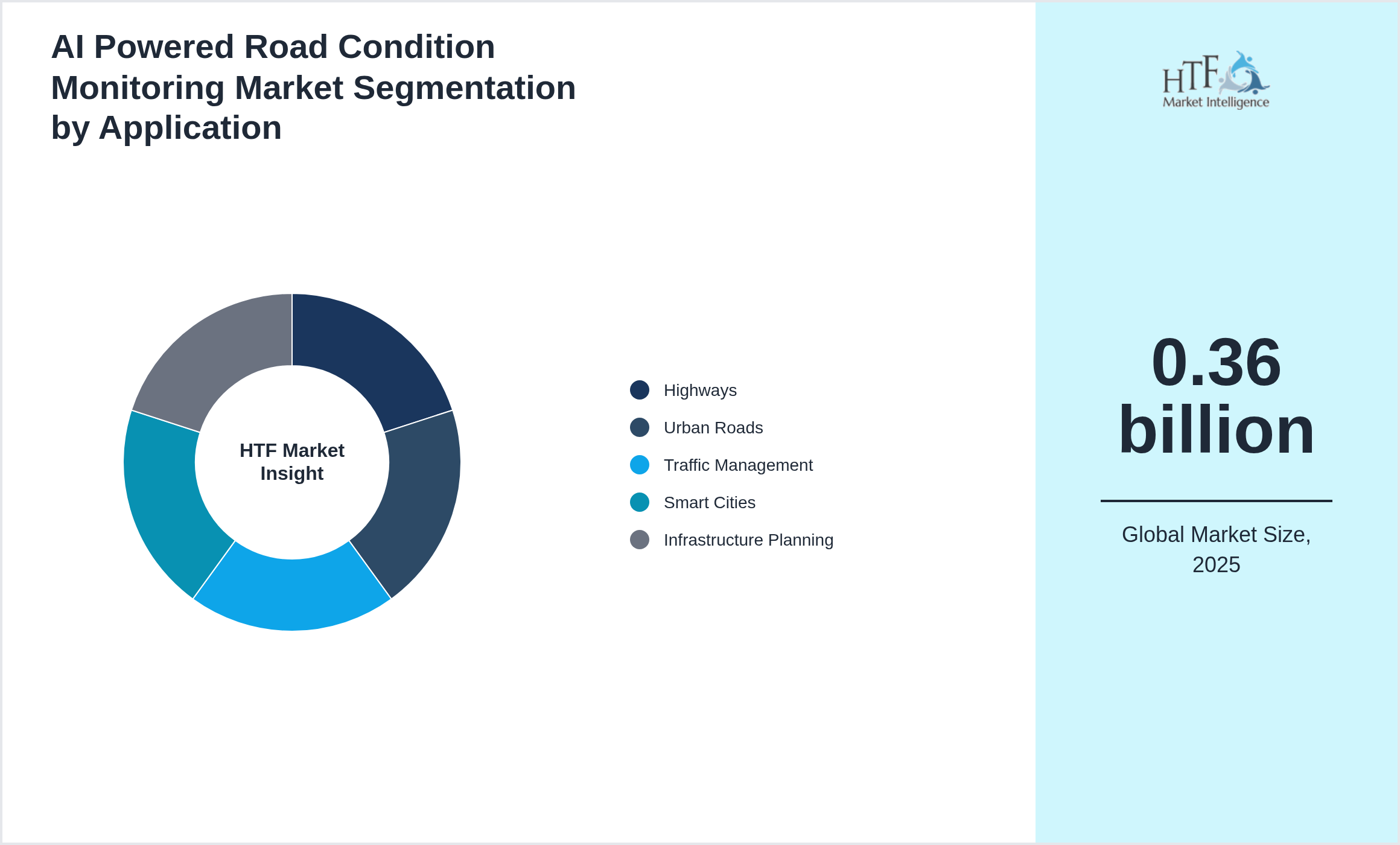
Understand Key Market Dynamics
Regional Analysis
- North America
- LATAM
- West Europe
- Central & Eastern Europe
- Northern Europe
- Southern Europe
- East Asia
- Southeast Asia
- South Asia
- Central Asia
- Oceania
- MEA
Market Entropy
- • Q4 2025: Real-time AI vision and sensor networks detected pavement deterioration and hazards reducing maintenance response time by 33% and improving driver safety metrics by 28%
- • Q3 2025: Predictive road health analytics enabled proactive maintenance scheduling lowering repair costs by 24% and minimizing traffic disruption across urban and highway networks
- • Q2 2025: IoT-enabled integration with municipal infrastructure improved data standardization by 27% and enabled centralized monitoring dashboards
- • Q1 2025: Investment in scalable sensor networks expanded coverage enhancing predictive accuracy and supporting automated asset management initiatives
Merger & Acquisition
- • Dec 2025 – Harman announced the acquisition of ZF Group’s ADAS business to expand camera radar compute and vehicle perception capabilities. The deal supports AI-powered road condition monitoring by strengthening sensor fusion environmental perception driver-assistance data hazard detection and real-time vehicle intelligence for safer roads
Regulatory Landscape
- • Governed by transportation safety regulations infrastructure monitoring standards and public asset management guidelines.
Patent Analysis
- • AI Powered Road Condition Monitoring utilizes cameras sensors drones and machine learning algorithms to detect pavement defects hazards and infrastructure degradation. Patent activity focuses on image recognition systems predictive maintenance models and autonomous inspection technologies.
Investment and Funding Scenario
- • Government funding infrastructure modernization programs and technology investments drive market growth and deployment.
Competitive Innovation Radar
- • Computer vision analytics drone-based inspections predictive maintenance algorithms and real-time road quality assessments significantly improve infrastructure management efficiency.
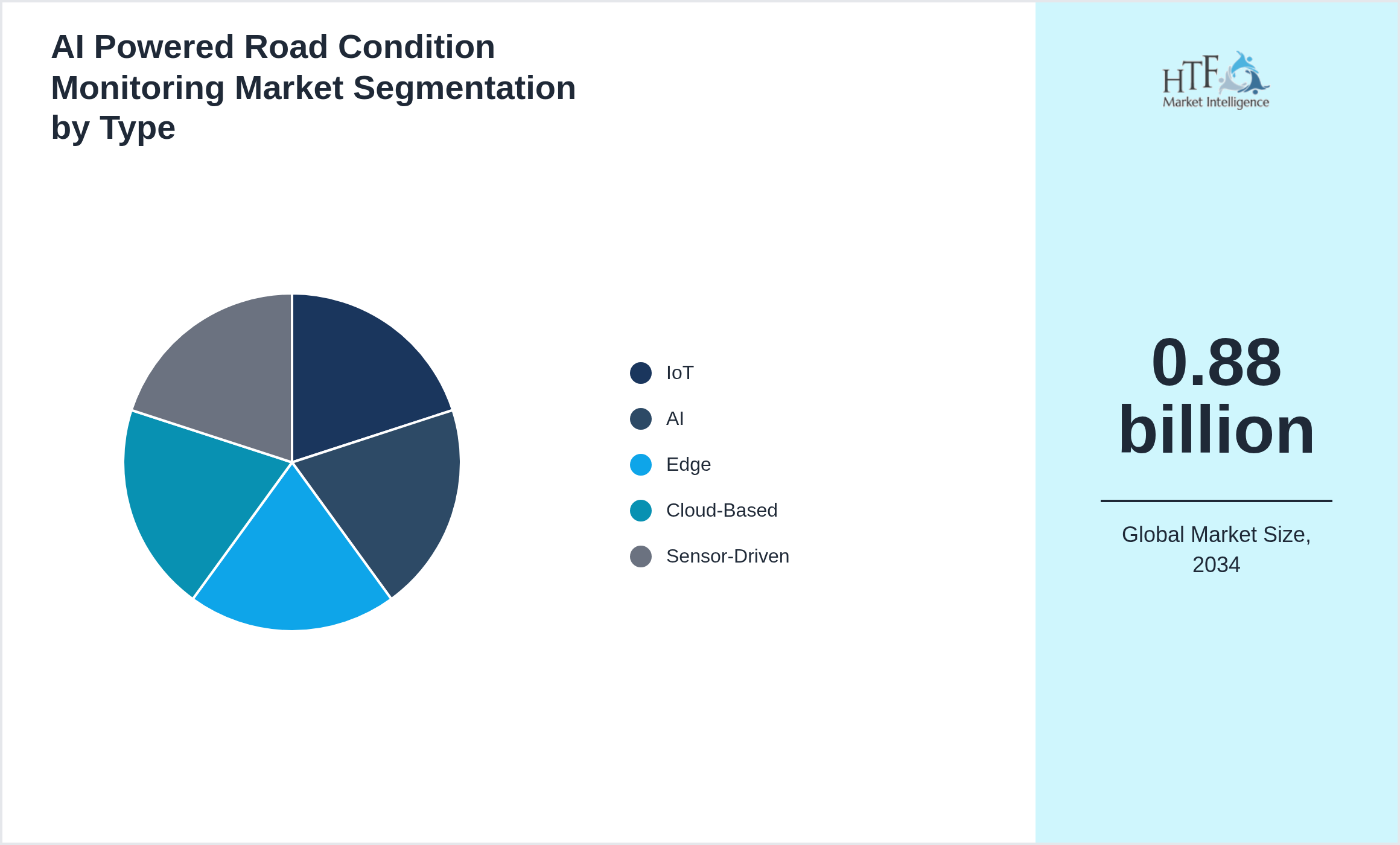
Market Driver
Market Trends
Opportunity
Challenges
Primary & Secondary Approach
The AI Powered Road Condition Monitoring is analyzed by both primary and secondary research sources. There are numerous methodologies available to navigate and utilize these resources effectively:
Surveys and Questionnaires: Getting feedback from healthcare professionals, patients, or any other stakeholders on a particular topic. It is a great method to collect quantitative data on behaviors, preferences, and/or experiences.
One-on-ones: Interviews with key stakeholders, including physicians, nurses, and administrators, can yield rich qualitative data. The interviews can be divided into structured, semi-structured, or unstructured.
Focus Groups: Pull together small numbers of people who share a common characteristic, trait, or behavior to discuss particular topics. Focus Groups: This offers qualitative data and points of view that are often overlooked, such as attitudes, perceptions, or other statements relating to a specific platform.
Observational Studies: Understanding healthcare practices and patient interactions in the way we do it can say a lot more than what people formally report doing.
Field Studies: This method allows researchers to collect data firsthand from healthcare settings, including hospitals, clinics, and even homes. It is a way to touch and feel the context that drives service delivery in healthcare.
Secondary Research in AI Powered Road Condition Monitoring
Secondary research is a kind of revising, restructuring, and rethinking what has already been collected by primary sources. Such research is beneficial as long as it comes at a low cost and gives an overarching view of the market. Some of the important methods include:
Literature Review: To go through the research papers, articles, and studies published in medical journals, industry reports, and academic publications. This is crucial for understanding the study landscape and identifying knowledge deficits.
Reports From the Industry: It aims at examining reports published by market research firms, healthcare associations, and government bodies. This report can also be used by all stakeholders, including service providers and delivery chains across the world, to identify market opportunities in an undetermined depth.
Public Health Records: Data collected by governments and public health authorities in different countries of the world from organizations with global reach, like the CDC, WHO, or national departments. These are important because they provide us with epidemiological data and numbers.
Company Reports: Read the annual reports, financial statements, and press releases of healthcare companies. It includes company performance reports, market strategies, and competitive positioning for this domain.
Online Databases: You understand the access to databases like PubMed, MEDLINE, and even Google Scholar for scientific articles and study materials. Some of these databases are treasure troves for peer-reviewed data.
Media Sources: Analyzing news articles, press releases, and media coverage related to the healthcare industry. This helps in staying updated on recent developments and emerging trends.
A blended approach of primary and secondary research methods allows researchers to collect well-rounded, solid data that informs the best decisions and strategies.
Report Infographics:
| Report Features | Details |
| Base Year | 2025 |
| Based Year Market Size (2025) | 0.36 billion |
| Historical Period Market Size (2021) | USD Million ZZ |
| CAGR (2025 to 2034) | 13.50% |
| Forecast Period | 2026 to 2034 |
| Forecasted Period Market Size (2034) | 0.88 billion |
| Scope of the Report | Type, Application, Region |
| Quantitative Units |
Revenue in USD million/billion, volume in kilotons, and CAGR from 2025 to 2034 |
| Year-on-Year Growth | 12.20% |
| Companies Covered | Siemens Mobility (Germany), Bosch (Germany), Huawei (China), Nokia (Finland), Ericsson (Sweden), IBM (USA), Intel (USA), Trimble (USA), Cisco (USA), Peloton Technology (USA), Mobileye (Israel), Sensys Networks (Sweden), Streetline (USA), Iteris (USA), Inrix (USA), Waycare (Israel), Kapsch TrafficCom (Austria), Swarco (Austria), TomTom (Netherlands), HERE Technologies (Netherlands) |
| Customization Scope | 15% Free Customization (For EG). Customized purchase options are available to match your specific research requirements |
| Delivery Format | PDF and Excel through Email |
Research enthusiast focused on transforming data uncovering into actionable insights through data-driven decision-making.