
Unlocking the Power of Contactless EMV Cards in 2024
Explore how contactless EMV cards revolutionize payments with speed, security, and convenience. Discover trends, benefits, and future outlook in this compreh...

Introduction
In today’s fast-paced digital economy, consumers demand speed, convenience, and security when making payments. Contactless EMV cards have emerged as a game-changer, transforming how individuals and businesses conduct transactions worldwide. Whether you’re tapping your card at a coffee shop or using it for public transit, these cards offer a seamless payment experience with enhanced fraud protection.
This article dives deep into the world of contactless EMV cards, exploring their technology, real-world applications, market trends, benefits, and the challenges shaping their future. By the end, you’ll understand why these cards are critical to the evolution of payment systems and how they’re driving innovation across industries.
Technology & Concept Overview
Contactless EMV cards combine two crucial technologies: EMV chip technology and near-field communication (NFC). EMV, standing for Europay, Mastercard, and Visa, refers to the global standard for chip-based debit and credit cards, designed to improve payment security by generating unique transaction codes that are difficult to clone or replicate.
Contactless payment leverages NFC, a wireless communication technology that enables devices to exchange data within a short range (typically 4cm or less). When a contactless EMV card is held near a payment terminal equipped with an NFC reader, the card transmits encrypted payment information securely and instantly, eliminating the need to insert or swipe the card.
Key terms to know include:
- EMV Chip: Embedded microchip on the card that stores payment data securely.
- NFC (Near-Field Communication): A short-range wireless technology enabling contactless interactions.
- Tokenization: Replacing sensitive card details with unique tokens during transactions to enhance security.
- Contactless Limit: The maximum transaction amount that can be completed without additional verification (e.g., PIN).
In essence, contactless EMV cards marry enhanced security with convenience, enabling quick tap-and-go payments without compromising safety.
Industry Applications & Use Cases
The adoption of contactless EMV cards spans multiple industries, from retail to transportation and hospitality.
In retail, major chains like Walmart and Starbucks have integrated contactless payments at checkout counters, speeding up lines and improving customer satisfaction. For example, Starbucks reported that implementing contactless payments increased transaction speed by up to 50%, directly boosting customer throughput during peak hours.
Public transportation systems worldwide have embraced this technology as well. London’s Oyster card system and New York City’s MetroCard are being supplemented or replaced by contactless EMV card payments, allowing commuters to tap their bank cards directly on readers, eliminating the need for separate transit cards.
Financial institutions have also launched contactless EMV cards to meet rising consumer expectations. Visa and Mastercard report millions of new contactless cards issued annually, reflecting strong consumer demand. Additionally, hospitality businesses such as hotels and restaurants use these cards to streamline payments, reduce physical contact—a crucial factor during the COVID-19 pandemic—and enhance guest experiences.
Another compelling use case is in vending machines and kiosks, where contactless cards enable fast, hygienic transactions without cash handling.
Market Trends & Growth Drivers
The global market for contactless EMV cards is experiencing rapid growth, driven by evolving consumer behavior and technological advancements. According to a 2023 report by Juniper Research, contactless card transactions are projected to exceed 300 billion globally by 2025, representing a compound annual growth rate (CAGR) of over 20%.
Key growth drivers include:
- Consumer preference for convenience: The rise of on-the-go lifestyles demands quick payment methods.
- Increased smartphone penetration: Smartphones often complement contactless card usage via mobile wallets, encouraging broader acceptance.
- Heightened security awareness: EMV chips mitigate fraud risks associated with traditional magnetic stripe cards.
- Regulatory encouragement: Governments and payment networks incentivize contactless adoption to improve payment infrastructure resilience.
Furthermore, the COVID-19 pandemic accelerated contactless payment adoption due to hygiene concerns, pushing retailers and consumers to embrace tap-to-pay solutions. This momentum continues, with emerging markets like India and Southeast Asia rapidly increasing their contactless card issuance and usage.
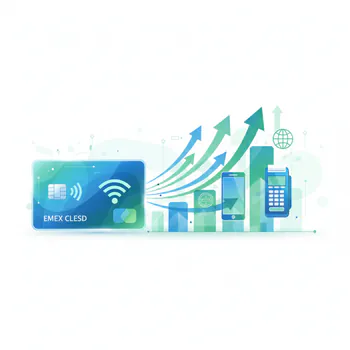
Market Trends & Growth Drivers
Benefits & Advantages
The benefits of contactless EMV cards extend to consumers, merchants, and financial institutions alike.
- Speed and convenience: Transactions typically take less than a second, reducing wait times and improving customer satisfaction.
- Enhanced security: The EMV chip generates unique cryptograms for each transaction, making card cloning and fraud significantly more difficult. Tokenization further protects sensitive data.
- Reduced wear and tear: As users tap instead of swiping or inserting cards, physical damage decreases, extending card lifespan.
- Lower operational costs: Faster transactions reduce labor costs at points of sale and improve throughput.
- Improved hygiene: Contactless payments remove the need for physical contact with payment terminals, a critical advantage during health crises.
From an ROI perspective, businesses adopting contactless EMV card readers often see increased transaction volumes and customer retention. For example, retailers report up to a 30% increase in throughput during busy hours. Additionally, the reduced risk of fraud translates into lower chargeback costs and improved bottom lines.
Challenges & Future Outlook
Despite their many advantages, contactless EMV cards face some challenges. One notable limitation is the contactless transaction limit, which restricts the maximum amount allowed without PIN verification. While this improves security, it can limit usability for higher-value purchases.
Another challenge is merchant adoption, especially among small businesses that may be reluctant to invest in new point-of-sale terminals due to cost concerns or lack of technical expertise.
Addressing security concerns is ongoing. While EMV technology significantly reduces fraud, emerging threats like relay attacks and NFC skimming require continuous innovation. Solutions such as biometric authentication and dynamic CVV codes are under development to enhance security further.
Looking ahead, experts predict continued growth in contactless EMV card adoption, fueled by advancements in chip technology and integration with mobile payment platforms. The emergence of dual-interface cards, combining contact and contactless capabilities with mobile wallet compatibility, will drive a more unified payment experience.
Moreover, the convergence of payment technologies with the Internet of Things (IoT) and wearables hints at a future where contactless payments become even more seamless and integrated into everyday life.
Conclusion
Contactless EMV cards represent a pivotal advancement in payment technology, blending convenience, speed, and enhanced security to meet the demands of modern consumers and businesses. Their widespread adoption across retail, transportation, hospitality, and beyond underscores their transformative impact.
For businesses, embracing contactless EMV technology is not just about staying current—it’s a strategic move to improve customer experience, reduce fraud, and drive operational efficiency. As market trends continue to favor contactless solutions, companies investing in this technology are well-positioned to capitalize on future growth opportunities.
In a world increasingly shaped by digital innovation, contactless EMV cards will remain at the forefront of secure, efficient, and user-friendly payment systems, paving the way for the next generation of financial transactions.
Need More Details on Market Players and Competitors?
Tagged in